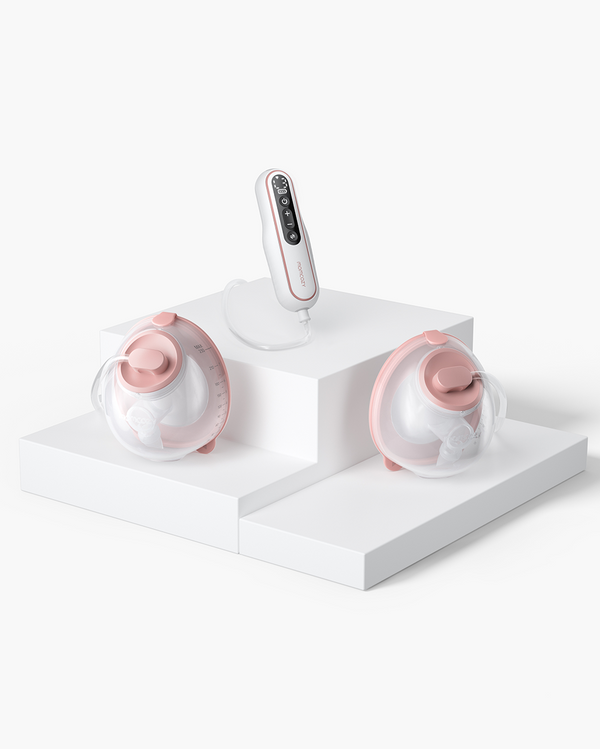
A bottle turns up every three hours in the first few months, then every four, then alongside solids and a sippy cup and whatever else ends up on the highchair tray. In an Australian kitchen, that rhythm eventually turns into arithmetic at the sink: how many bottles are dirty, how long the kettle takes, whether the dishwasher has room.
That arithmetic is really the whole bottle steriliser vs washer question. The two appliances are not rivals competing for the same job. One removes the milk. The other deals with what the milk leaves behind. Understanding which one you are missing is what stops you buying the wrong machine, or buying both when one would have done.
Bottle steriliser vs washer: what each machine actually does
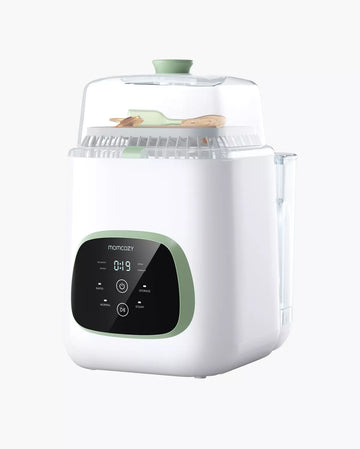
A bottle washer is a small dishwasher built around the shape of a bottle. Water is pushed through jets at pressure, the racks are designed to hold teats and collars upright, and the cycle ends with heated drying. On the Momcozy KleanPal Pro, that means 22,000Pa of wash pressure through 26 multi-angle jets, a 2.5L tank per cycle, and up to 4 bottles plus pump parts in one load, with the shortest cycle running 19 minutes.
A steriliser does something narrower and, in its own way, more specific. It applies heat and steam to a bottle that has already been washed, to deal with microorganisms the wash did not remove. There is no detergent step and no brush, so a steriliser never touches the fat and protein film that milk leaves on the inside shoulder of a bottle.
 Member price
From$549.99Code Save 25%
 Member price
$552.99Code Save 20%
 Member price
$589.00
$619.00Code Save 25%
Australian infant feeding guidance treats these as two steps in one sequence, not two options. Pregnancy, Birth and Baby is direct about it: separate all the parts, wash with hot water and dishwashing detergent and a bottle brush, including the thread where the cap screws on, and only then sterilise. The washing carries the physical work. The sterilising carries the microbiological work.
- A washer removes milk residue, fat and dried formula from surfaces it can reach.
- A steriliser applies heat, usually steam, to a bottle that is already physically clean.
- Neither one is a substitute for the other, and neither one is optional if you are following Australian guidance for a baby under 12 months.
Do Australian families really need both?

Not always, and the answer depends less on the appliance than on what goes into the bottle.
Pregnancy, Birth and Baby draws a distinction that surprises a lot of parents who have read American feeding advice: sterilising matters most for formula, while for expressed breast milk, cleaning with warm soapy water is usually enough. The same service still advises sterilising the bottle and teat before each use if you are bottle feeding, and recommends continuing until 12 months, so most households end up sterilising most days regardless. If your baby was premature, is unwell, or has a weakened immune system, the advice is to talk to your child health nurse about extra steps rather than to guess.
The volume question is the one that decides whether a machine earns its bench space. Four bottles a day is manageable by hand. Eight to ten bottles a day, plus pump parts, plus a toddler, is where hand washing stops being a task and becomes a background anxiety. Families with twins, families exclusively formula feeding, and families where one parent is back at work within a few weeks are the ones who feel the difference first.
There is also a maintenance question people forget until the first winter. A steriliser that only sterilises leaves you washing by hand before every cycle. A washer that only washes leaves you without the step Australian guidance asks for. The reason combination machines exist is that the two steps sit next to each other in the same routine, on the same bench, roughly six times a day.
If you would rather compare models than categories, the bottle washer range sets out how the current Momcozy range splits between washers and sterilisers.
Momcozy KleanPal Pro at a glance
The KleanPal Pro is the model Momcozy sells in Australia, and the numbers below are the ones published on the Australian product page. Everything else in this article uses these figures, not the specifications of models sold in other markets.
- Function: washes, steam sterilises, dries and stores in one unit
- Capacity: up to 4 bottles per cycle, plus teats, collars and pump parts
- Wash pressure: 22,000Pa through 26 multi-angle jets, including 12 directional jets
- Modes: 9 combinations, including Rapid, Normal, Steam and Storage
- Cycle times: Rapid Wash from 19 minutes, Normal Wash 29 minutes, Sterilise + Dry 60 minutes, Storage up to 72 hours
- Steam temperature: 100°C
- Water use: 2.5L per cycle, with Momcozy claiming up to 86.7% less water than hand washing and up to 94.7% less than a standard dishwasher
- Hygiene claim: Momcozy states the unit eliminates 99.9% of germs, alongside 72-hour hygienic storage
- Materials: food-grade, BPA-free
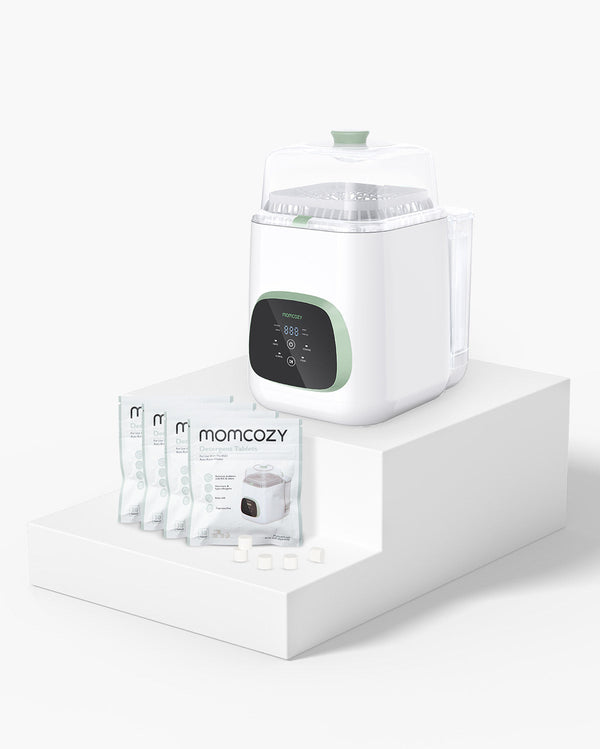
- Maintenance: descale every 20 cycles with Momcozy Descaling Tablets; direct drainage hose for emptying
- In the box: 60 official Momcozy bottle washer tablets
- Price: A$549.99; SKU BS003-GW10NB-A; 1-year warranty
 Member priceFrom$549.99Code Save 25%
 Member price$552.99Code Save 20%
 Member price$589.00
$619.00Code Save 25%
Cleaning, sanitising and sterilising: what Australian guidance means
The three words get used interchangeably in product marketing and they do not mean the same thing. Getting them straight is what makes the buying decision simple.
Cleaning is the removal of visible milk, formula and grease. It is the bottle brush, the hot water, the detergent, the dishwasher, the washer. Its success is measured by whether anything is left on the surface.
Sanitising is a reduction step, usually achieved with very hot water or a chemical solution, that lowers the number of bacteria on a surface that has already been cleaned. It is a lower bar than sterilising and, in Australian consumer advice, it is rarely the word used for baby bottles.
Sterilising is the step Australian guidance actually names. Pregnancy, Birth and Baby lists three accepted methods for formula feeding equipment: boiling, steam sterilisation and chemical sterilisation. Steam sterilisers heat water to boiling point so the steam does the work; boiling means fully submerging the parts in a saucepan for 5 minutes with the lid on; chemical sterilising uses a solution or tablets prepared exactly as directed, with a fresh batch made daily.
That list is worth reading closely, because it tells you what "sterilised" means in an Australian kitchen. It is a practical reduction of germs using heat or chemicals, following a manufacturer's instructions and, for steam units, choosing one that meets Australian Standards. It is not laboratory sterility, and no consumer appliance sold here claims to be.
One genuinely local detail: Pregnancy, Birth and Baby notes that UV sterilisers are available to buy in Australia but that there are no national guidelines for their safe use. UV cabinets are widely stocked and heavily marketed, and if you are considering one, that gap is the thing to weigh rather than the marketing copy.
Does a steriliser replace washing?
No, and the failure mode is worth understanding because it is invisible.
Dried milk and formula form a film that sits between the steam and the surface underneath. Steam sterilises what it can reach. A bottle with residue in the shoulder or the teat base still has residue after the cycle, and that residue is a food source. CHOICE makes the same point from the cleaning side: wash bottles and teats in hot soapy water to remove all traces of milk or formula, because any residue provides a breeding ground for bacteria.
So the sequence has to be wash, then sterilise, in that order, every time. A washer that also steam sterilises and dries collapses those steps into one load, which is the only reason a combination machine is more than a convenience. It is not doing less than the manual routine; it is doing the same routine without you standing at the sink.
Member price
From$549.99Code Save 25%
Member price
$552.99Code Save 20%
Member price
$589.00
$619.00Code Save 25%
How long do you need to sterilise bottles in Australia?
Until your baby is 12 months old. That is the figure used by Pregnancy, Birth and Baby, which recommends properly washing and sterilising bottles used for feeding until 12 months, and by Australian infant feeding guidance generally. After 12 months, thorough washing is the routine, with sterilising reserved for illness or advice from your health team.
The daily cadence matters as much as the end date. Pregnancy, Birth and Baby advises sterilising bottles every day, and notes that if a bottle has not been used within 24 hours of being sterilised, it needs sterilising again. Dry sterilised equipment should be stored in a clean container with a lid, and can be kept in the fridge for up to 24 hours.
The 24-hour rule in practice
This is the rule that catches people out, because a bottle that looks perfectly clean and has sat in a drying rack overnight is no longer considered sterile. The practical version most households settle on is a rolling cycle: wash and sterilise in the evening, use through the next day, and re-sterilise anything still sitting unused at the 24-hour mark.
A storage mode changes the arithmetic without changing the rule. The KleanPal Pro offers up to 72 hours of hygienic storage in a closed, dried cabinet, so equipment left in the machine runs past the 24-hour mark. Anything you take out is back on the 24-hour rule.
Steam, UV, microwave or boiling: choosing a method
Australian guidance accepts boiling, steam and chemical sterilising, and One Fine Baby's Australian buying guide adds microwave steam units to the practical list. Each suits a different household.
Steam sterilising
Electric steam sterilisers are the default for daily use because they are fast, need no chemicals, and many models now dry as well. Capacity is the specification that separates them: some electric models hold six to nine bottles, while compact units hold fewer. For a household running eight feeds a day, capacity decides how many cycles you run, and cycles decide how much of the evening disappears.
UV cabinets
UV cabinets sterilise without water or steam, which appeals in small kitchens and for items that tolerate heat badly. The catch is coverage: UV only affects surfaces the light reaches, so loading and validated performance claims matter more than they do with steam. Combined with the absence of national guidelines for UV use in Australia, that makes UV a category where reading the manufacturer's validated instructions is not optional.
Microwave, boiling and chemical
Microwave steam sterilisers are the cheapest entry point and are genuinely portable, which is why they turn up in holiday houses and grandparents' kitchens. Boiling works and costs nothing beyond a saucepan, but it needs five minutes of supervision and carries a scald risk that matters in a house with a toddler. Chemical sterilising, using solutions or tablets, is useful for travel and for items that cannot take heat, and needs a fresh batch daily.
Dishwasher vs bottle washer
A dishwasher is a cleaning appliance, not a sterilising one, and Australian guidance treats it that way. Healthdirect allows a dishwasher set on the hottest cycle for cleaning expressing equipment when your baby was born at term and is healthy, but the same guidance separates that from sterilising bottles for a baby under 12 months.
Member price
From$549.99Code Save 25%
Member price
$552.99Code Save 20%
Member price
$589.00
$619.00Code Save 25%
There are practical limits beyond the terminology. Dishwasher jets are designed for plates and bowls, so a bottle loaded at an angle may only be rinsed rather than washed. Detergent tablets formulated for a full load can leave a film on small parts. And high heat in a domestic dishwasher is not kind to thin-walled bottles or silicone teats, which is why manufacturers publish their own temperature limits.
A dedicated bottle washer differs mainly in geometry: the jets point where bottles actually need them, the racks hold parts upright, and the cycle is short enough to run several times a day. If your dishwasher is already running twice daily and the bottles are riding along in the gaps, that is a reasonable arrangement. If you are hand-rinsing before loading and hand-washing the teats afterwards anyway, the dishwasher is not saving you the step you wanted it to save.

Australian water, scale and steam sterilising
Steam sterilisers heat water, and Australian tap water carries dissolved minerals that plate out as scale on the heating element and the inside of the chamber. BabyCenter's Australian steriliser guide is blunt about it: to stop stubborn mineral scale building up, you really need distilled water rather than standard tap water.
Scale is not cosmetic. A scaled element takes longer to reach temperature, which stretches every cycle, and heavy build-up is one of the reasons a steriliser that worked well in its first year starts underperforming in its second. One Fine Baby lists descaling among the ongoing costs buyers should budget for, alongside replacement filters, cleaning tablets and UV lamps.
How you manage it depends on your water. If you are in a hard-water area, distilled water in the tank is the simplest fix, and it is cheap relative to the appliance. If you use tap water, descale on a schedule rather than when performance drops. The KleanPal Pro's interval is every 20 cycles with Momcozy Descaling Tablets, which for a household running three or four cycles a day works out to roughly weekly.
What you can buy in Australia, and what to check
The Australian market splits into three price bands, and knowing them stops a A$549.99 appliance from looking either extravagant or like the obvious answer.
- Under A$50: microwave steam sterilisers and portable chemical kits. BabyCenter's Australian guide lists a Tommee Tippee microwave steriliser at about A$40 from Chemist Warehouse and a Milton Solo portable kit at about A$40 from Big W. One Fine Baby lists a Kmart microwave steriliser at A$17. These sterilise but do not wash or dry.
- A$150 to A$350: electric steam sterilisers and dryers, typically at Baby Bunting and the major baby retailers. One Fine Baby lists a Minbie steam steriliser and dryer at A$220; BabyCenter lists a NUK Vario Express at A$149.
- A$500 and above: combination washers that wash, sterilise, dry and store. One Fine Baby names the Baby Brezza Bottle Washer Pro and the Mumilk 3-in-1 in this category, and notes they are more expensive, take up more bench space, and may need specific cleaning tablets or filters.
What to check before you spend
- Capacity per cycle against your actual bottle count, not the average.
- Whether the unit dries, and how, because wet bottles at the end of a cycle send you back to the rack.
- Bench footprint and lid clearance, measured rather than estimated.
- Ongoing costs: tablets, filters, descaler, replacement parts.
- Compatibility with your bottles, teats and pump parts, checked against the instructions for both.
- Warranty length and who services it in Australia.
The KleanPal Pro is sold direct through the Momcozy Australian store, and the steriliser range covers the steam-only options.
Member price
From$549.99Code Save 25%
Member price
$552.99Code Save 20%
Member price
$589.00
$619.00Code Save 25%
Frequently asked questions about bottle sterilisers in Australia
Is a bottle steriliser or a bottle washer better for an Australian household?
Neither is better in isolation, because Australian guidance asks for washing followed by sterilising. If you can only buy one machine, buy the one that removes the step you hate most. Households drowning in bottles usually get more relief from a washer; households already hand-washing comfortably usually get more from a steriliser and dryer.
Do I still need to sterilise after 12 months?
No. Pregnancy, Birth and Baby recommends washing and sterilising feeding equipment until your baby is 12 months old, after which thorough washing is the routine. If your child is unwell or was born premature, ask your child health nurse whether to continue.
Can I use the dishwasher instead of a bottle washer?
For cleaning, sometimes, if the load is arranged so jets reach inside the bottles and the cycle is the hottest your machine offers. For sterilising, no: a dishwasher is a cleaning step, and Australian guidance still separates sterilising for babies under 12 months.
How long can a sterilised bottle sit before I re-sterilise it?
Pregnancy, Birth and Baby advises re-sterilising a bottle that has not been used within 24 hours, and storing dry sterilised equipment in a clean lidded container, where it can stay in the fridge for up to 24 hours. A storage mode on a machine extends the closed-cabinet window, but the 24-hour guidance is the safer default.
Are UV sterilisers a safe choice in Australia?
They are legal to buy and widely stocked, but Pregnancy, Birth and Baby notes there are no national guidelines for their safe use in Australia. If you go that route, load the cabinet exactly as the manufacturer specifies and check the validated performance information rather than relying on general claims.
How often should I descale a steam steriliser?
Follow the manufacturer's interval rather than a calendar. The KleanPal Pro specifies descaling every 20 cycles, which is roughly weekly at three to four cycles a day. In hard-water areas, using distilled water reduces how often you need to do it.
Is the Momcozy KleanPal Pro worth A$549.99?
It is worth it if you want washing, 100°C steam sterilising, drying and storage in a single 4-bottle load, and if you would otherwise be hand-washing several times a day. It is not worth it if you sterilise occasionally, have very little bench space, or are happy with a A$40 microwave unit plus a bottle brush.
Member price
From$549.99Code Save 25%
Member price
$552.99Code Save 20%
Member price
$589.00
$619.00Code Save 25%