What a bottle washer actually does
A bottle washer is a benchtop appliance with one job: clean the things that touch milk. Bottles, teats, screw caps, valves, membranes and breast pump parts go onto a rack, and a single cycle washes, rinses, sterilises, dries and then holds everything until you need it. No sink of hot soapy water, no bottle brush, no tea towel draped over a drying rack.
That narrow focus is the entire point. A dishwasher has to be competent at plates, saucepans and wine glasses, so its spray pattern is a compromise across all of them. A bottle washer only has to be good at the awkward geometry of feeding equipment: the narrow neck of a 240ml bottle, the inside of a silicone teat, the small valve that disappears into a cutlery basket. If you want to compare dedicated machines first, the full bottle washer range is the place to start.
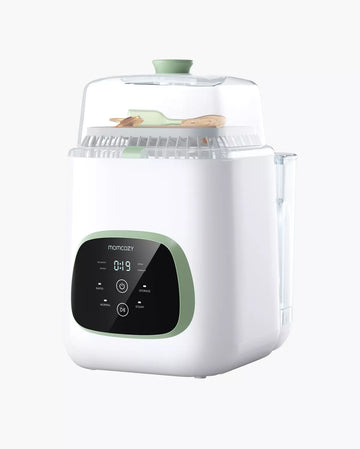
The Momcozy KleanPal Pro is the machine used as the reference point throughout this guide. It is the model Momcozy sells in Australia, and its specification shows what this category can realistically do: up to 4 bottles in one cycle, 22,000Pa of wash pressure delivered through 26 multi-angle jets, nine mode combinations, and a storage mode that holds equipment clean for up to 72 hours after the cycle ends.
 Member price
From$549.99Code Save 25%
 Member price
$589.00
$619.00Code Save 25%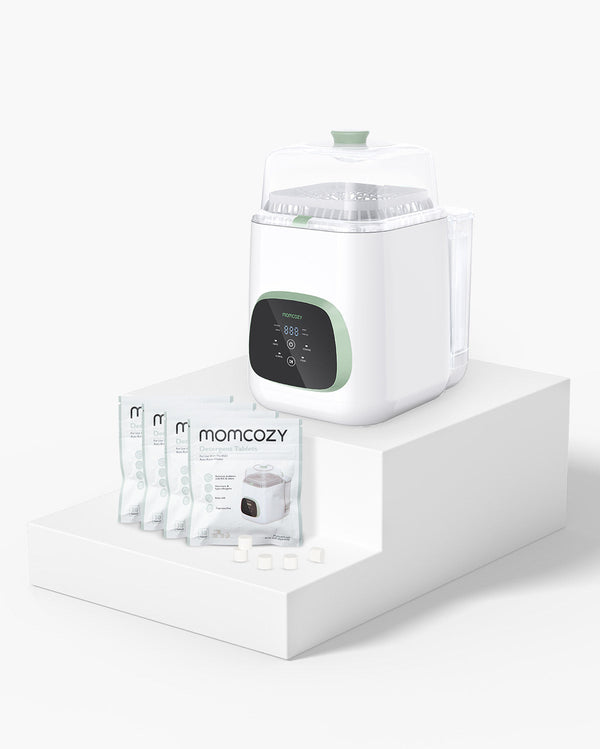 Member price
$552.99Code Save 20%

Momcozy KleanPal Pro at a glance
- Price: A$549.99
- Capacity: up to 4 bottles in one cycle
- Wash pressure: 22,000Pa through 26 multi-angle jets, including 12 directional jets
- Modes: 9 combinations, including Rapid, Normal, Steam and Storage
- Cycle times: Rapid Wash from 19 minutes, Normal Wash 29 minutes, Sterilise + Dry 60 minutes
- Sterilising: 100°C steam
- Water: 2.5L tank per cycle, with a direct drainage hose
- Water saving: up to 86.7% less than hand washing and up to 94.7% less than a standard dishwasher, based on Momcozy's own testing
- Storage: up to 72 hours of hygienic storage once the cycle finishes
- Materials: food-grade and BPA-free
- Maintenance: descale every 20 cycles using Momcozy Descaling Tablets
- In the box: 60 official Momcozy bottle washer tablets
- Warranty: 1 year. SKU BS003-GW10NB-A
Treat those as a ceiling: plenty of Australian households are well served by less.
Member price
From$549.99Code Save 25%
Member price
$589.00
$619.00Code Save 25%
Member price
$552.99Code Save 20%
What a dishwasher does well, and where it stops short
Dishwashers are genuinely good machines. They use hot water, detergent and rotating spray arms, and the better ones run a drying phase. For a mixed load of dinner plates they are difficult to argue with, and Australian guidance does not tell you to avoid them.
Pregnancy, Birth and Baby, for instance, notes that for expressing equipment you could also use a dishwasher set on the hottest cycle. That is a legitimate shortcut for pump parts.
Where the logic bends is specificity. Spray arms are designed to hit broad, flat surfaces at a workable angle. A bottle neck is a hole the width of a twenty-cent coin. A teat is a dome with a pinhole in it. A pump valve is a scrap of silicone smaller than your thumbnail. Water reaches those surfaces at whatever angle the rack happens to present, and nothing in the cycle adapts to the shape of the object.
Then there is the difference between clean and sterile, which are not the same thing. One Fine Baby makes the point directly in its Australian steriliser guide: milk residue needs to be thoroughly removed before sterilisation, and even the most expensive appliance will not make up for bottles that were not cleaned properly. A dishwasher is excellent at removing residue from plates; it does not follow that every teat came out residue-free.
Heat is the third issue. CHOICE notes silicone withstands repeated washing, boiling and sterilising far better than rubber, but tolerance still varies by part and the care instructions are the only reliable guide. One Fine Baby's guide is explicit that some pump components can be exposed to steam while others may be damaged by heat or need a different cleaning method entirely. A dishwasher drying phase is not gentle by design, because it was never designed around parts this thin.
Bottle washer vs dishwasher: the head-to-head
The core difference is design intent. A dishwasher handles a mixed load; a bottle washer handles one specific load, repeatedly, with the same result each time.
Member price
From$549.99Code Save 25%
Member price
$589.00
$619.00Code Save 25%
Member price
$552.99Code Save 20%
Cleaning precision
A dishwasher applies a general spray pattern to a mixed rack. A bottle washer builds its pressure and spray geometry around bottle shapes and pump parts. In practice that means the KleanPal Pro pushes 22,000Pa through 26 multi-angle jets into places a rotating arm rarely reaches cleanly, and it does so on every cycle rather than on the cycles where the rack happened to load well.
Cycle time and predictability
A dishwasher runs long because it is washing a mixed batch, and most households wait until it is full before starting it. That waiting period is the real cost: dirty bottles sit in the machine for hours. A bottle washer runs small batches frequently, which matches how often bottles are actually used. The KleanPal Pro takes 19 minutes on Rapid Wash, 29 on Normal Wash and 60 for Sterilise + Dry, and those times do not shift with how you loaded it.
Sterilising
This is where the two machines diverge most sharply. Pregnancy, Birth and Baby lists exactly three ways to sterilise feeding equipment for formula feeding: boiling, steam sterilisation and chemical sterilisation. A dishwasher is not on that list.
That matters because of the time frame. Australian guidance is consistent that bottles should be washed and sterilised until your baby is 12 months old, and that if a sterilised bottle has not been used within 24 hours it needs sterilising again. A dishwasher's hottest cycle is a washing step. It does not reset that 24-hour clock in the way a dedicated steam cycle does.
The KleanPal Pro sterilises with 100°C steam as a distinct stage of the cycle, then dries, then holds. Momcozy also states the machine eliminates 99.9% of germs, which is the manufacturer's own claim rather than an independently verified figure.
Water and power use
A dishwasher is efficient per plate and inefficient per bottle: you rarely run it for four bottles. The KleanPal Pro uses a 2.5L tank per cycle and, on Momcozy's testing, uses up to 94.7% less water than a standard dishwasher and up to 86.7% less than hand washing. Those percentages come from the manufacturer, so read them as directionally true rather than laboratory-grade.
Bench space, price and running costs
A dishwasher costs nothing extra and takes no additional bench. A bottle washer costs A$549.99 and occupies a fixed patch of kitchen real estate, which in an Australian apartment kitchen is often the binding constraint. Running costs are modest but not zero: descaling tablets every 20 cycles, plus the 60 washer tablets supplied in the box.
Australian conditions that change the answer
Most English-language comparisons of these two machines are written for a North American kitchen. Three local factors genuinely shift the calculation.
Humidity and drying
Australia's humid climates make a wet bottle a worse outcome than it is in a dry one. BabyCenter's Australian guide notes that in humid conditions wet bottles left sitting can breed bacteria, which is why a built-in drying cycle is worth more here than it looks on paper. The drying stage is not a convenience feature; it is the step that stops the whole cycle being undone.
The KleanPal Pro runs drying as part of the cycle and then holds equipment in a closed, hygienic state for up to 72 hours, which suits overnight setups and batch washing.
Tap water and scale
Australian tap water varies by region, and harder water leaves mineral scale on heating plates and inside bottles. BabyCenter's guide recommends distilled water over standard Australian tap water to stop stubborn mineral scale building up in steam appliances.
If you would rather not buy water, the practical answer is a descaling routine you actually keep to. Momcozy specifies descaling every 20 cycles with its Descaling Tablets on the KleanPal Pro. Skip it and the steam performance degrades quietly, which is exactly the kind of maintenance failure that makes people give up on an appliance and go back to the sink.
What you can buy here, and what it costs
The Australian market is well supplied. BabyCenter lists four sterilising options recommended here: electric steam, microwave steam, cold water or chemical, and UV cabinets. One Fine Baby's 2026 round-up prices a steam steriliser and dryer from around A$220 (Minbie) up to A$350 for a UV cabinet (Omababy), with the Baby Brezza Bottle Washer Pro, an all-in-one washer, at A$599.95. You will find these categories at Baby Bunting, Kmart and the major online baby retailers.
That price ladder is useful context for A$549.99. A steriliser-only appliance is cheaper because it does less: you still wash by hand first. An all-in-one washer sits above it because it replaces the washing step as well.
Is your dishwasher enough for baby bottles?
For low volume, honestly, yes. If you are washing one or two bottles a day, a dishwasher handled sensibly will do the job. Load bottles and teats on the top rack, away from the heating element, use a mild detergent, and make sure everything is properly dry before it goes into a cupboard.
Two caveats come from Australian guidance. The first is that a dishwasher clean is not a sterilised bottle. Pregnancy, Birth and Baby is clear that bottles need sterilising until 12 months and need re-sterilising if unused after 24 hours, so a dishwasher-only routine leaves that step unaddressed. Most families in this situation run a small steam steriliser alongside it, which works fine.
The second caveat is small parts. Pump valves, membranes and teat rings are the components most likely to be lost, bent or left out of a dishwasher load, because they are too small for the racks to hold reliably. If your routine includes expressing, those parts are the ones that matter most and the ones a dishwasher serves worst.
The warning signs: cloudy residue on bottles after a cycle, milk film in teat holes, or a dishwasher you run twice a day and still can't keep up with.
Which one should you choose?
Work backwards from volume, not from features.
- One or two bottles a day, formula or mixed feeding. A dishwasher plus a small steam steriliser is the sensible spend. A dedicated washer is a luxury here, not a necessity.
- Three or four bottles a day, plus occasional pump parts. This is the crossover point. A washer starts earning its bench space because hand-washing disappears, and the drying and storage stages remove the clutter.
- Five or more bottles a day, or exclusive pumping. A dedicated machine is close to essential. At this volume you are washing equipment two or three times a day, and the time cost of hand washing is the dominant expense, not the A$549.99.
- Twins, or a toddler plus a newborn. Same answer as above, sooner. Volume doubles before your routine exists.
One more thing that never shows up in comparisons: whether you will keep using it. An appliance that is awkward to load or too tall for your bench gets abandoned within a month, and then you have paid A$549.99 for a drying rack. Measure your clearance first.
Member price
From$549.99Code Save 25%
Member price
$589.00
$619.00Code Save 25%
Member price
$552.99Code Save 20%
How to choose a bottle washer in Australia
Match the machine to your actual routine rather than to the longest feature list.
Capacity
Count what a real day produces, then divide by how often you will run a cycle. The KleanPal Pro handles up to 4 bottles per cycle, which covers a full day for many formula-feeding households in one or two loads. If you are exclusively pumping with a double pump, count the collection parts as well as the bottles.
Cycle functions
Some machines wash only. Some wash, sterilise and dry in one pass. In a humid Australian climate the drying stage is the one to insist on, and the storage stage is what lets you run a cycle at 9pm and not think about bottles again until morning. Check cycle times rather than mode count: 19 minutes for a rapid wash differs a lot from 60.
Pump parts and small components
If pump parts are in your daily load, check that the rack and jets are designed for curved and irregular shapes, and that small valves have somewhere specific to sit. This is the single most common gap between a machine that works and one that quietly misses the parts that matter.
Running costs, servicing and warranty
Add up consumables before you buy: descaling tablets, washer tablets, replacement filters if the model has them. One Fine Baby's buying guide flags exactly this, noting that ongoing costs including filters, cleaning tablets and descaling are easy to overlook when comparing sticker prices. Check the warranty length too, and whether servicing is handled in Australia; the KleanPal Pro warranty page sets out what is covered. The KleanPal Pro carries a 1-year warranty and ships with 60 washer tablets.
Member price
From$549.99Code Save 25%
Member price
$589.00
$619.00Code Save 25%
Member price
$552.99Code Save 20%
Frequently asked questions about bottle washers and dishwashers in Australia
Can I put baby bottles in my dishwasher?
Yes, on the top rack and away from the heating element, provided the manufacturer says the bottle and teat are dishwasher safe. Australian guidance explicitly allows a dishwasher on its hottest cycle for expressing equipment, so the appliance itself is not the problem. What a dishwasher does not do is sterilise to the standard Australian guidance asks for under 12 months.
Do I still need to sterilise if I use a dishwasher?
Yes. Pregnancy, Birth and Baby lists three sterilising methods for feeding equipment, boiling, steam and chemical, and a dishwasher cycle is not one of them. Bottles should be washed and sterilised until your baby is 12 months old, and re-sterilised if a sterilised bottle sits unused for more than 24 hours.
When can I stop sterilising bottles?
Australian guidance points to 12 months. Pregnancy, Birth and Baby advises washing and sterilising bottles until your baby is 12 months old, and One Fine Baby's guide repeats the same threshold. If your baby was born prematurely, is unwell or has specific medical needs, ask your midwife, child health nurse or GP about a longer or different routine.
Will a dishwasher warp bottles, teats or pump parts?
It can, depending on the part. Heat tolerance varies between silicone, polypropylene and the thinner plastics used in pump valves, and One Fine Baby notes some pump components tolerate steam while others may be damaged by heat. Check the care instructions for each part rather than assuming dishwasher safe on the bottle extends to the teat.
Do I need filtered water in a bottle washer?
Not necessarily, but scale is a real issue in hard water areas. BabyCenter's Australian guide recommends distilled water rather than standard tap water to stop stubborn mineral scale building up in steam appliances. If you use tap water, descale on schedule. Momcozy specifies every 20 cycles for the KleanPal Pro.
Is a bottle washer worth it if I only use a few bottles a day?
Usually not. At one or two bottles a day, a dishwasher plus a small steam steriliser costs a fraction of A$549.99 and covers the same ground. The economics change at around three or four bottles a day, or as soon as pump parts join the daily load, because that is when hand washing stops being a minor chore.
What is the difference between a bottle washer and a steriliser?
A steriliser only sterilises, so everything still has to be washed by hand first. A bottle washer does the washing, rinsing, sterilising and drying in one cycle. That is why a steam steriliser with a dryer starts around A$220 in Australia while all-in-one washers sit several hundred dollars higher, and why One Fine Baby's guide points out that sterilising and cleaning are not the same job.
The bottom line
The honest answer to bottle washer vs dishwasher depends on volume. If you are washing a bottle or two a day, a dishwasher on its hottest cycle plus a steam steriliser meets Australian guidance comfortably, and spending A$549.99 would be hard to justify.
If you are washing four or more bottles a day, or expressing, the arithmetic flips. A dishwasher cannot sterilise to the standard Australian guidance asks for under 12 months, cannot reliably clean a pump valve, and makes you wait until it is full while dirty bottles sit on the bench. A dedicated machine solves all three, dries properly in a humid climate, and holds equipment clean for up to 72 hours.
For that group, the Momcozy KleanPal Pro is a fair benchmark: 4 bottles a cycle, 22,000Pa through 26 jets, 100°C steam, a 19-minute rapid wash and 72-hour storage, at A$549.99 with a 1-year warranty. Whether it suits your kitchen comes down to bench space, water and daily bottle count, not which appliance wins outright.