Scale does not announce itself. The machine still fills, the lid still seals, and the cycle still finishes on time — but the teats come out with a chalky film, water spots dry onto the bottles, and the wash feels softer than it did in the first month. On a bottle washer, that pattern usually means mineral scale rather than a fault.
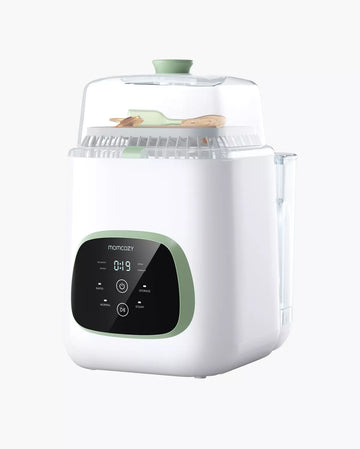
Scale is a water problem before it becomes a machine problem. Every fill leaves a thin mineral residue behind as the water dries, and heat bakes it onto the jets, the tank walls and the heating surfaces. Descaling dissolves that film while it is still soft; once it hardens, no rinse will shift it. This guide follows the Momcozy KleanPal Pro Baby Bottle Washer and Steriliser, the model Momcozy sells in Australia, and the maintenance routine that keeps it washing properly.
 Member price
From$549.99Code Save 25%
 Member price
$589.00
$619.00Code Save 25%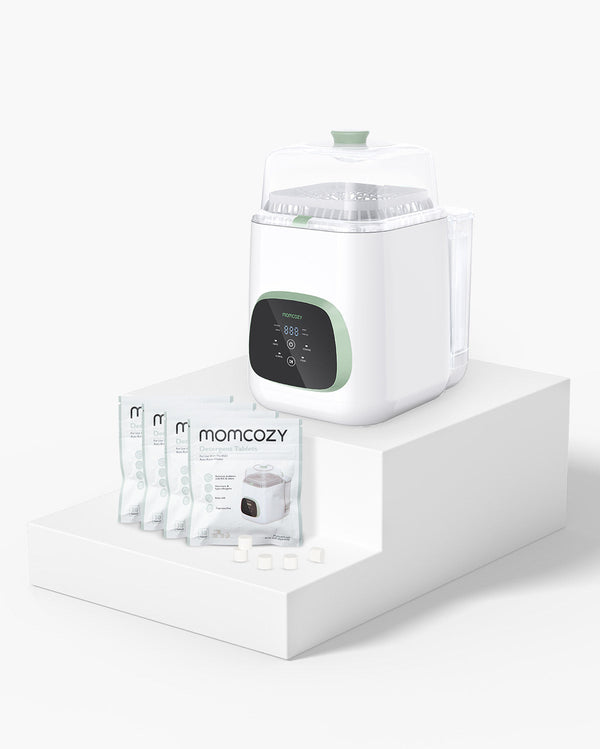 Member price
$552.99Code Save 20%

Why a bottle washer scales up
Tap water carries dissolved calcium and magnesium. Inside a bottle washer those minerals meet heat, steam and milk residue, and the combination sets into a hard film on every surface the water touches. How quickly that happens depends on your supply: the more minerals the water carries, the sooner the film appears. A kettle that furs up within a few weeks is a fair proxy for what the 2.5-litre tank is dealing with.
If you fill from the tap, the same water that furs the kettle goes into the machine. Filtered or distilled water carries a much lower mineral load, which slows scale rather than preventing it.
On the KleanPal Pro, scale shows up in four ways:
- It narrows the 26 multi-angle jets, so the 22,000Pa spray arrives weaker than it left the pump.
- It coats the tank walls and heating surfaces, so each cycle works harder for the same result.
- It leaves spots and a chalky film on teats and bottle threads that looks like a cleaning failure but is a water deposit.
- It traps milk residue, and residue is what bacteria feed on between washes. CHOICE's bottle feeding guide is blunt about the mechanism: milk or formula left on bottles and teats gives bacteria a place to grow.
None of that means every weak wash is scale. A tightly packed basket, a teat sitting over a jet and a clogged filter all produce similar symptoms, so check the ordinary causes before you reach for a tablet.
Momcozy KleanPal Pro at a glance
The KleanPal Pro is the Momcozy bottle washer sold in Australia, and it is the machine this guide follows. These are the figures from the AU product page:
Member price
From$549.99Code Save 25%
Member price
$589.00
$619.00Code Save 25%
Member price
$552.99Code Save 20%
- Capacity: up to 4 bottles in one cycle
- Wash pressure: 22,000Pa through 26 multi-angle jets
- Modes: 9 combinations, including Rapid, Normal, Steam and Storage
- Cycle times: Rapid Wash from 19 minutes, Normal Wash 29 minutes, Sterilise + Dry 60 minutes, Storage up to 72 hours
- Tank: 2.5 litres per cycle, with water savings of up to 86.7% against hand washing and 94.7% against a standard dishwasher
- Sterilising: 100°C steam, rated by Momcozy at 99.9% of germs
- Materials: food-grade and BPA-free
- In the box: 60 Momcozy bottle washer tablets
- Descaling: about every 20 cycles, using Momcozy Descaling Tablets
- Price and support: A$549.99, 1-year warranty
How to descale a bottle washer, step by step
The KleanPal Pro has no automated self-clean program, so descaling is a short manual routine rather than a button: one tablet, one wash cycle, one fresh-water rinse. Set aside about an hour of elapsed time and stay within earshot for the first cycle.
Step 1: Clear the machine
Take out bottles, teats, dummies and any removable parts, and leave the chamber empty. A descale is not a wash. Nothing should be inside while the tablet works, because the water has to reach the tank walls and jets without a load in the way.
Step 2: Fill the tank with fresh water
Fill the 2.5-litre tank with fresh water. Filtered or distilled water is the better choice here. It carries less mineral load, so the tablet spends its strength on the scale already in the machine rather than on minerals you have just added.
Step 3: Add one descaling tablet
Add one Momcozy Descaling Tablet to the machine with the fresh water and let it dissolve fully before the cycle ends. Momcozy's instructions call for its own tablet, not dishwashing liquid, dishwasher powder or a vinegar pour. Detergents are built to lift food off plates and leave their own residue in a closed tank; a descaling tablet is built to dissolve minerals.
Step 4: Run a Normal Wash
Select Normal Wash and let the 29-minute cycle run to the end. Water circulates through the jets, the tank and the internal lines, dissolving scale as it goes. Do not open the lid mid-cycle — the tablet needs the full contact time to do its work.
Step 5: Rinse with fresh water only
Drain the machine, refill with fresh water and run a second cycle with no tablet. Rapid Wash, at 19 minutes, is the short option on this machine. This flushes loosened mineral debris and any remaining tablet residue out of the lines so it does not dry back onto the jets.
Step 6: Dry, reassemble and check the flow
Let the machine cool, wipe the tank and chamber dry, and look at the jets against a light: clear holes, no white crust. Refit the removable parts and run a rinse cycle before the next bottle wash. If flow is still weak after that, the cause is more likely a tightly packed load, a blocked filter or a jet that is not seated than scale.
How often should you descale a bottle washer in Australia?
Momcozy recommends descaling about every 20 cycles, and that count is the most practical trigger a household has. It is not a fixed date, because 20 cycles can leave very different amounts of scale depending on what comes out of the tap.
Two things move the interval:
- Water. If your kettle furs up in weeks, shorten the interval. If you fill with filtered or distilled water, you can usually run the full 20 cycles.
- Volume. Twenty cycles is 20 cycles whether they take a fortnight or a month. A household washing about four bottles a day runs roughly one cycle a day, so a descale lands every three weeks or so. A household running two cycles a day gets there in about ten days.
- Source. Bore water and tank water can carry more mineral and sediment load than a treated mains supply, which usually means a shorter interval.
Treat the 20-cycle mark as the default and the first sign of a chalky film as the signal to bring it forward. Coming forward costs one tablet; ignoring it costs wash performance for weeks before you notice why.
Signs it is scale, and what it is not
Scale has a recognisable signature, but it shares symptoms with three or four ordinary problems. Work through this list before assuming the machine needs a descale:
- Chalky white film on teats and bottle threads: mineral deposit, and the clearest sign of all.
- Water spots that dry onto the bottles: the same minerals, left behind as the water evaporates.
- Weaker spray from the jets: scale narrowing the holes, though a clogged filter gives an identical result.
- A warm or musty smell between cycles: usually milk residue in the filter or drainage hose rather than scale.
- Grinding or rattling mid-cycle: something is touching a spray arm or sitting against the tank wall. Rearrange the load before descaling.
If the film returns within a few cycles of a descale, the water is the problem rather than the routine.
Descale and sterilise are two different jobs
Descaling removes minerals. Sterilising kills germs. A machine can be scale-free and still need sterilising, and a sterilised bottle can still come out spotted if the jets are furred.
Member price
From$549.99Code Save 25%
Member price
$589.00
$619.00Code Save 25%
Member price
$552.99Code Save 20%
Pregnancy, Birth and Baby advises washing and sterilising bottles for as long as your baby is using them, up to 12 months, and lists boiling, steam sterilisation and chemical sterilisation as the three accepted methods. It also notes that there are no national guidelines in Australia for the safe use of UV sterilisers, which is worth knowing if you are comparing machine types.
The KleanPal Pro sterilises with 100°C steam, and Sterilise + Dry runs for 60 minutes. The machine also holds a hygienic storage cycle for up to 72 hours, which saves running a fresh sterilise after every feed.
One Australian detail is worth keeping straight. Pregnancy, Birth and Baby advises re-sterilising a bottle that has not been used within 24 hours. Treat the 72-hour storage cycle as a hygiene feature of the machine, not as an override of that advice: if a bottle has been sitting since yesterday, run it through again.
If you are deciding between washing and sterilising as separate jobs, the baby bottle sterilisers collection shows the standalone options.
Preventing scale between descales
Descaling fixes what has already set. Four habits slow the next round:
- Do not leave water in the tank. Empty and dry it after the last cycle of the day. Standing water leaves its minerals on the walls as it evaporates.
- Rinse milk residue before loading. Residue left to dry hardens onto jets and racks, and the wash cycle then has two problems to solve instead of one.
- Use filtered or distilled water for the tank, at least for the descale cycle itself.
- Keep the consumables straight. The washing blocks for KleanPal Pro handle the everyday wash; the Momcozy Descaling Tablets handle maintenance. Mixing them up is the most common reason a descale achieves nothing.
A 30-count box of descaling tablets covers 30 descales, or about 600 wash cycles. For most families that is close to a year of routine care, so the cost of staying on top of scale is small compared with a machine that washes badly for months.
Frequently asked questions about descaling a bottle washer in Australia
Member price
From$549.99Code Save 25%
Member price
$589.00$619.00Code Save 25%
Member price
$552.99Code Save 20%
How often should I descale my bottle washer?
About every 20 cycles on the KleanPal Pro, or sooner if you see a chalky film on the tank walls, teats or jets. Households on bore or tank water, or with a kettle that furs quickly, usually need to shorten that interval.
Can I descale with vinegar instead of tablets?
Use the Momcozy Descaling Tablets. Vinegar and citric acid are useful for wiping hard-water crust off a tap or a kettle, but they are not the recommended charge for a closed tank and fine jets, and the proportions people mix at home vary too much to be reliable.
Where does the descaling tablet go?
Into the machine with fresh water in the tank and the chamber empty. Do not run a wash load at the same time. The tablet needs the water to itself so it can reach the jets and tank walls at full strength.
Does descaling sterilise the bottles as well?
No. Descaling removes mineral scale from the water path; sterilising is a separate 100°C steam cycle. Run Sterilise + Dry when you need germ reduction and descale when you need to clear scale. The machine will happily do one without the other.
What happens if I never descale?
Scale narrows the jets, cuts the effective spray and leaves spots on everything that comes out. Left long enough it also traps milk residue in the filter and drainage hose, which is where the smell comes from. The machine keeps running — it just stops performing the way it did.
My bottles feel greasy after a wash. Is that scale?
Usually not. A greasy film points to milk fat that was not rinsed off before loading, or to a load packed too tightly for the jets to reach every surface. Scale feels chalky or rough rather than greasy.
How long does a descale take?
Plan on roughly an hour: a 29-minute Normal Wash with the tablet, a drain and refill, and a second short cycle — Rapid Wash from 19 minutes — to rinse. Add cooling and drying time before you reassemble.
Can I use dishwasher tablets or dishwashing liquid to descale?
No. Those are formulated for a different machine and leave their own residue in a closed tank. Use the descaling tablets the machine was designed around.
Keep your bottle washer running like new
Descaling is the least glamorous part of bottle feeding and the part that decides whether the machine still works properly in year two. Twenty cycles, one tablet, a wash cycle and a rinse — that is the whole routine, and it takes less time than hanging out a load of washing.
Keep a box of Momcozy Descaling Tablets with the machine, note the cycle count when you descale, and shorten the interval the moment the film comes back early. If flow stays weak after a descale, the FAQ and support pages cover the common causes, and the warranty policy sets out what is covered in Australia.
If you are still choosing a machine, the bottle washers collection has the current range, and the KleanPal Pro product page carries the full specification.