How long a sterile bottle actually stays sterile
Start with the number that governs everything else. Pregnancy, Birth and Baby is direct: if your baby's bottles have not been used after 24 hours, they need sterilising again. The same guidance ends the routine at 12 months, once a baby's immune system has matured enough for washing alone.
Twenty-four hours is a ceiling on the whole chain, not just the cycle: the machine finishing, the bottle drying, the cap going on, the bottle sitting wherever you store it. A household running one evening cycle and using the bottles next day sits comfortably inside it. The trouble starts when a Sunday cycle leaves a bottle that resurfaces in the nappy bag on Wednesday.
A spotless bottle still expires, because sterilising leaves no coating behind. It resets the surface, and from then on the bottle is only as clean as the last thing that touched it — a damp hand, a teat on the bench.
There is one official shortcut. The same guidance says dry, sterilised equipment can be kept in a clean container with a lid, and stored in the fridge for up to 24 hours. It is the only storage method Australian advice puts a time on, and it is a fridge number, not a cupboard number.
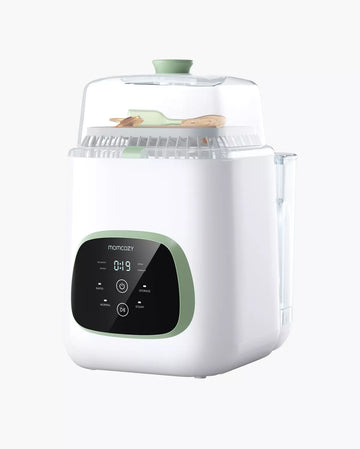
Momcozy KleanPal Pro at a glance
A machine with washing, drying and a storage cycle does not change the biology. It changes the handling count: fewer hands on the bottle after the cycle, and a defined place for it to sit. The Momcozy KleanPal Pro is this guide's reference point.
 Member price
From$549.99Code Save 25%
 Member price
$589.00
$619.00Code Save 25%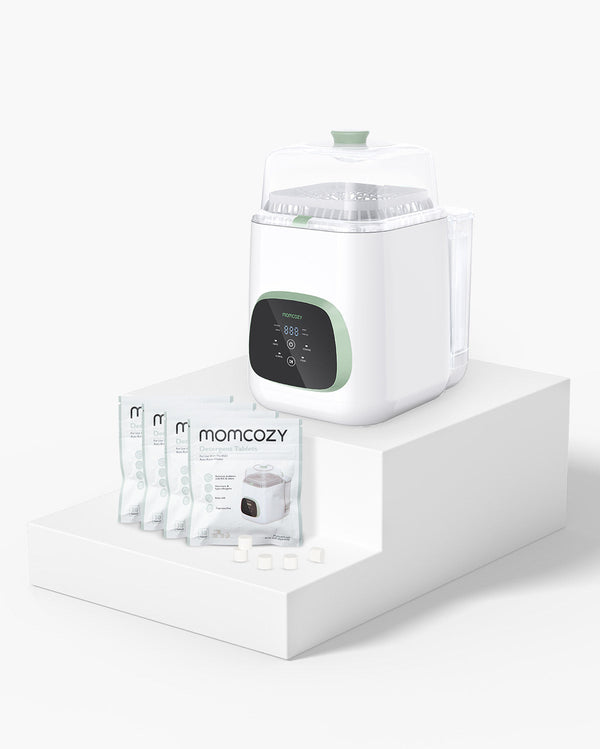 Member price
$552.99Code Save 20%

- Price: A$549.99 from Momcozy's Australian store, with 60 official bottle washer tablets in the box
- Capacity: up to 4 bottles in one cycle, plus teats, caps and pump parts
- Washing: 26 multi-angle jets at 22,000 Pa, across 9 mode combinations
- Cycle times: Rapid Wash 19 minutes, Normal Wash 29 minutes, Sterilise + Dry 60 minutes
- Steam: 100°C, with Momcozy rating the cycle at 99.9% of germs eliminated
- Storage: up to 72 hours of hygienic storage once the cycle finishes
- Water: 2.5 litres per cycle, which Momcozy puts at 86.7% less than handwashing and 94.7% less than a standard dishwasher
- Drainage: a direct drainage hose, so wastewater leaves the unit rather than sitting in a tank
- Materials: food-grade and BPA-free
- Warranty: 1 year, SKU BS003-GW10NB-A
Three ways to store sterile bottles at home
Every method below is a variation on one idea: dry, covered, away from anything that carries germs. What differs is cost, bench space and how often you touch the bottle.
Leave them in a machine with a storage cycle
The least-handled option is to never take the bottles out. A storage cycle keeps the load enclosed after washing, steaming and drying finish, and the KleanPal Pro runs it for up to 72 hours. Load four bottles, run Sterilise + Dry, and the machine becomes the storage: press Storage with Sterilise and it holds the load, press Sterilise alone and it stops when sterilising ends.
Be precise about the 72 hours: it is Momcozy's specification for how long the storage cycle runs, with the load enclosed and dry. Australian advice still asks you to re-sterilise a bottle that has sat unused for 24 hours, so treat the cycle as an enclosed holding bay, not permission to feed a three-day-old bottle.
Descale every 20 cycles, Momcozy's stated interval, using Momcozy Descaling Tablets. In harder water — peri-urban Perth, Adelaide, parts of regional Victoria — that arrives sooner in calendar terms than most people expect. Detergent comes as Momcozy's own washing tablets, sold in a larger block once the 60 in the box run out.
Member price
From$549.99Code Save 25%
Member price
$589.00
$619.00Code Save 25%
Member price
$552.99Code Save 20%
Use a clean lidded container in a cupboard
Cheapest method, and the one most kitchens already have the parts for. It also has the least margin for error, because a cupboard is not a sterile environment. What you are doing is giving the bottles clean, dry, enclosed space.
- Dedicate one shelf and one lidded food-grade container to feeding equipment
- Keep it away from the stove, the kettle and any cupboard that warms up through the afternoon
- Keep it away from the sink, the bin and the dishwasher door, where splashes travel
- Do not store bottles beside onions, garlic or raw meat, and label the container if more than one adult does drop-off
The cupboard method has no official time limit, which is why the 24-hour rule does the work here. A lidded container does not extend the window; it removes the obvious ways for it to be cut short.
Use the fridge
Fridge storage is the only method with an official number, and it comes with conditions: dry equipment, a clean lidded container, up to 24 hours. A wet bottle in a sealed container is worse than a dry one in the open, because the moisture stays put.
- Use the back of a shelf rather than the door, where the temperature swings every time it opens — healthdirect gives the same advice for expressed milk
- Never put a warm bottle in; let the dry stage finish first
- Store below and away from raw meat, never above food eaten uncooked
- Take out only what the next feed needs
Storing bottles through an Australian summer
Most advice in this category was written for a Northern Hemisphere kitchen, and it shows. An Australian January is a different operating environment: 35°C afternoons, humidity that never quite leaves the air, ants that find a bench within the hour.
Three things change. The bench stops being cool, so a cupboard above the kettle in a west-facing kitchen is warm by mid-afternoon. The fridge has less spare shelf, because summer fills it with cut fruit, platters and Christmas lunch. And the laundry, garage and patio, where bottles get left to air dry, become warm and humid rather than cool.
What not to do is leave a made-up bottle out for later. Pregnancy, Birth and Baby advises throwing away formula or expressed breast milk left at the end of a feed, or after one hour — and a hot kitchen does not stretch that hour. Pre-making feeds for a day out means chilling them fast, keeping them cold, and treating a parked car like a warm room.
The workable summer setup: run the evening cycle after dinner when the kitchen is coolest, let the dry stage finish, and store in the machine or a lidded container rather than an open rack. Claim fridge shelf space before the day's food goes in.
Out of the house: capsules, prams and Australian childcare
Storage rules that work on a kitchen bench collapse quietly in a nappy bag, fastest in summer.
Packing for a pram or capsule
- Assemble and cap bottles at home, once they are properly dry, so nothing is loose in the bag
- Use an insulated bag and freezer brick for longer outings
- Never store bottles in a pram basket or capsule boot on a hot day; a parked pram is hotter than the air around it
- Carry boiled water in a thermos and make up the feed when you need it, rather than carrying made-up feeds for hours
- Pack one more sterile bottle than you think you need, and bring unfinished ones home
What long day care actually asks for
Long day care and family day care services generally assume you supply your baby's bottles: labelled, enough for the day, formula pre-measured or made up to the service's policy, and a name on every cap and teat rather than just the bag. Send bottles already through a cycle and capped, and count them at drop-off so the same number comes home.
Ask three questions before the first day: whether the service refrigerates made-up feeds, whether it warms bottles and how, and whether bottles come home rinsed. Policies differ between services and states, so the enrolment pack is the authority.
The drying step decides whether a cycle holds
Moisture is the part everyone underestimates. A bottle that comes out wet and is capped wet holds a film of water inside, and a warm, closed, damp space is the best conditions a bottle will get all day. Australian guidance is to store sterilised equipment dry in a clean container with a lid.
The machine is the easier half: a drying stage inside the enclosure finishes the job without anything in the kitchen touching the bottle. Air drying on an open bottle drying rack works, but dust, flies and a humid February all slow it down.
Two habits decide the rest. Do not towel-dry the inside of a bottle with the tea towel that dried the dishes. And wash and dry your hands before handling sterilised bottles and teats, which guidance names as one of the easiest ways to contaminate freshly cleaned equipment.
Teats deserve their own line. CHOICE recommends checking teats regularly by pulling on the bulb to test their strength, and discarding worn ones immediately. Silicone stands up to repeated washing, boiling and sterilising far better than rubber, which goes sticky and friable — but a split teat is a leak and a choking risk.
Pump parts, dummies and the 12-month finish line
Expressing equipment follows different rules, which catches out parents who assume everything in the freezer bag needs the same treatment. The Australian Breastfeeding Association is clear that if your baby is full term and healthy, your own expressing equipment does not need to be disinfected or sterilised — just thoroughly cleaned at least once every 24 hours, including the collection parts and every container used to store milk. If your baby was premature or is unwell, follow your doctor or child health nurse instead.
Between sessions, the ABA suggests storing unrinsed parts in a closed container or plastic bag in the fridge until the next use, rinsing in cold water first if there is no fridge. That is storage advice, not sterilising advice, and for anyone expressing at work it is the biggest time-saver in the routine.
Dummies follow bottle logic: they go in a mouth, they get dropped, and they are worth running through a cycle with the bottles rather than rinsing under the tap. Keep spares in a lidded container.
The finish line for bottles is 12 months. Past that, hot soapy water and thorough drying becomes the routine — which is also when most households notice how much bench space the machine took.
Milk storage is a different clock
Keep these two sets of numbers apart. Bottle sterility is a 24-hour question; stored breast milk is a temperature question. healthdirect puts freshly expressed milk at no more than 6–8 hours at room temperature up to 26°C, and no more than 72 hours in a fridge at 5°C or below, at the back of the fridge rather than the door.
That 72 hours belongs to the milk, not the bottle. A bottle can be sterile with milk inside it already past its window, and fresh milk in yesterday's bottle is not rescued by being fresh.
Frequently asked questions about storing sterile bottles in Australia
Member price
From$549.99Code Save 25%
Member price
$589.00$619.00Code Save 25%
Member price
$552.99Code Save 20%
How long can a sterilised bottle sit before it needs another cycle?
Twenty-four hours, per national health advice: a bottle that has not been used in that window should be sterilised again. The clock starts when the cycle finishes, and every hand that touches the bottle shortens the odds.
Can I store sterile bottles in the fridge overnight?
Yes, if they are dry, in a clean container with a lid, and in the fridge for no more than 24 hours. Back of a shelf rather than the door, and away from raw meat.
The KleanPal Pro advertises 72 hours of storage. Which number applies?
Both, for different things. Seventy-two hours is how long the storage cycle runs with the load enclosed and dry. Twenty-four hours is when health advice says an unused bottle should go back through a cycle. So use the cycle to hold bottles, and still re-sterilise anything that sat past the day.
How should I store bottles on a 40-degree day?
In the machine with the storage cycle running, or in a lidded container in the fridge — not on a bench, in a cupboard above the kettle, or in a pram or car. Out of the house, use an insulated bag and discard anything warm for long.
What should I send to childcare?
Labelled bottles, already through a cycle and capped, plus enough for the day and formula measured to the service's policy. Count them at drop-off.
Do I still need to sterilise after 12 months?
Not as a daily routine. Guidance ties daily sterilising to the first 12 months; after that, hot soapy water, a bottle brush and thorough drying cover it — though a cycle is still useful when a bottle has been left somewhere unhelpful.
Can I store bottles with the teats and caps already on?
Yes, once everything is completely dry. Assembling a wet bottle and capping it traps moisture inside, which is the opposite of what storage is for. Short on time, store the parts separately and assemble at the feed.
What to do tonight
Pick one spot for sterile bottles — the machine, a lidded container in a cool cupboard, or the back of a fridge shelf — and make it the only place they live. Run the cycle, let the drying finish, cap them dry, count what is ready, then mark the 24-hour point. It decides whether tonight's work is still good tomorrow.
If you are still deciding what to run that cycle in, start with the bottle washer range or the steriliser range; the FAQ covers warranty and tablet questions.