When can you stop sterilising baby bottles in Australia?
Australian guidance gives you a date rather than a feeling. Pregnancy, Birth and Baby is blunt about the endpoint: bottles used for feeding should be properly washed and sterilised until your baby is 12 months old, and the same service advises sterilising the bottle and teat before each use. Teats and screw caps are part of that, not an afterthought. Parents who end up with a bottle steriliser on the bench are rarely ignoring the rule. They are trying to fit a wash, a sterilise and a dry into a day that already contains six to eight feeds.
The three-month finish line you will see quoted in a lot of English-language articles travels with North American guidance, where water treatment and public health messaging differ from ours, and it does not match what Australian parents are told at their child health checks. If you are weighing the two versions against each other, the local one is the version your maternal and child health nurse will ask you about at the next appointment.
The harder problem is rarely the rule itself. It is the handling: hot equipment, wet bench space, a drying rack that never empties. That is the gap a machine is meant to close, and it is why the rest of this Australian guide uses the Momcozy KleanPal Pro as its reference point. It is the model Momcozy sells here, and its specification shows what a single load can realistically cover.
 Member price
From$549.99Code Save 25%
 Member price
$589.00
$619.00Code Save 25%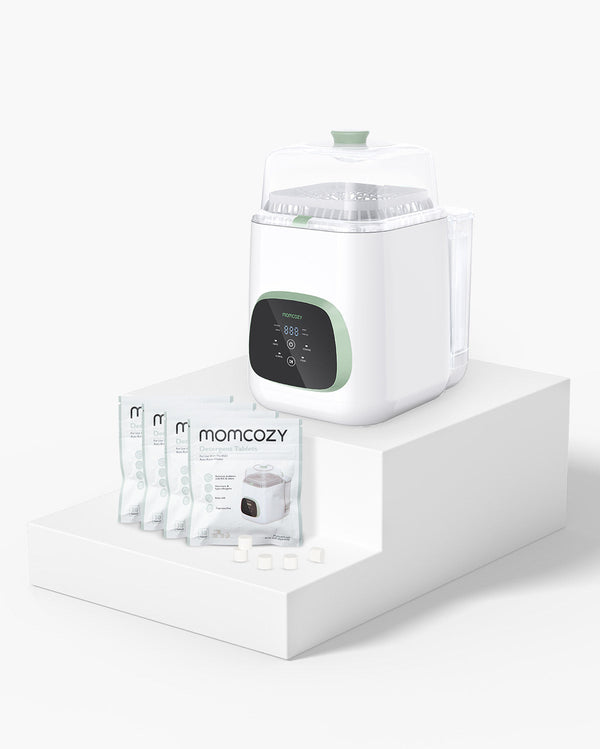 Member price
$552.99Code Save 20%

Momcozy KleanPal Pro at a glance
- Price: A$549.99
- Capacity: up to 4 bottles in one cycle
- Wash pressure: 22,000Pa through 26 multi-angle jets, including 12 directional jets
- Modes: 9 combinations, including Rapid, Normal, Steam and Storage
- Cycle times: Rapid Wash from 19 minutes, Normal Wash 29 minutes, Sterilise + Dry 60 minutes
- Sterilising: 100°C steam
- Water: 2.5L tank per cycle, with a direct drainage hose
- Water saving: up to 86.7% less than hand washing and up to 94.7% less than a standard dishwasher
- Storage: up to 72 hours of hygienic storage once the cycle finishes
- Materials: food-grade and BPA-free
- Maintenance: descale every 20 cycles with Momcozy Descaling Tablets
- In the box: 60 official Momcozy bottle washer tablets
- Warranty: 1 year. SKU BS003-GW10NB-A
Read those numbers as what one machine can do in a single load, not as what you need to buy. Plenty of Australian households are well served by a microwave steam bag and a drying rack.
Member price
From$549.99Code Save 25%
Member price
$589.00
$619.00Code Save 25%
Member price
$552.99Code Save 20%
Why bottles need sterilising in the first months
Milk is a near-perfect medium for bacterial growth, and a newborn arrives without the immune maturity to cope with a dose of the wrong thing. Pregnancy, Birth and Baby makes the point that even bottles and teats that look clean can still carry germs, which is the line worth remembering. Visible cleanliness is not the test you are applying when you decide whether a bottle is ready for a feed.
The load is not spread evenly across your equipment either. The Australian Breastfeeding Association notes that if your baby is full term and healthy you do not need to disinfect or sterilise your own expressing equipment, although it should be thoroughly cleaned at least once every 24 hours. Bottles and teats are the parts that deliver milk to a baby's mouth, and that is where the sterilising effort belongs.
How often should you sterilise bottles?
Before every use is the standard for the first months, and a daily cycle is the floor. Pregnancy, Birth and Baby states that you will need to sterilise your bottles every day, and that a bottle which has not been used within 24 hours needs sterilising again before it goes anywhere near your baby.
Somewhere between three and six months, most households move from sterilising after every feed to one sterilising cycle a day, with washing still happening after every feed. That is a reasonable adjustment for a healthy, full-term baby, provided the washing stays thorough: hot water and dishwashing detergent, a bottle brush kept only for bottles, the thread where the cap screws on cleaned properly, and hot soapy water squeezed through the teat hole so milk cannot sit in it.
Do you need to sterilise every day after 3 months?
Australian guidance does not move the finish line to three months, and it is worth saying that plainly, because a lot of content implies otherwise. What changes at three months is the margin for error rather than the rule. A healthy, full-term baby with a developing immune system copes with more, and many parents use that to drop from a sterilise per feed to one sterilise a day.
A few situations should keep you at full frequency regardless of age:
- Your baby was born before 37 weeks, or has a condition that affects immunity
- Your water comes from a tank, a bore or another untreated supply
- Your baby has had gastro or thrush in the past few weeks
- A bottle has been sitting out, or a feed was started and put back in the fridge
The 12-month mark: what actually changes
At 12 months the job changes rather than disappears. Australian guidance stops requiring sterilisation, and hot soapy water with a thorough rinse becomes the everyday standard. Teats, valves and screw caps still need washing and still need inspecting, and bottles still need to be dry before they are stored, because a sealed bottle with water in it is a nicer place for bacteria than a dry one.
If your baby turns one in the middle of an illness, or was premature, the date is a guide rather than a switch. The next section covers that.
Which babies need sterilising for longer
- Premature babies. Babies born before 37 weeks are the group most often told to keep sterilising past the usual point. Take the timeline from your child health nurse or paediatrician rather than from a calendar.
- Babies with immune conditions or chronic illness. The finish line is set by your paediatrician or child health nurse, not by a calendar.
- Tank, bore or untreated water. This is the common Australian version of the problem. Properties on rainwater tanks, and households on untreated regional supplies, are the ones where sterilising after every feed is cheap insurance rather than extra work.
- Recent gastro or thrush. Sterilise everything that goes in the mouth, including dummies, until you have had a clear run of well days.
- Second-hand or shared equipment. Bottles, teats and pump parts from another household get a full wash and a full sterilising cycle before first use.
Cleaning versus sterilising: two different jobs
Cleaning is physical work. Hot water, detergent and a brush lift milk fat and protein off the surface. Sterilising is the step that follows, using heat or chemicals to deal with what washing left behind. One Fine Baby is explicit that neither a steam appliance nor a UV cabinet replaces thorough washing beforehand, and that is the failure mode to guard against. A machine loaded with residue-coated bottles will bake that residue on.
Momcozy rates the steam cycle on the KleanPal Pro at 99.9% of germs, which is the number to compare against a steriliser's claims rather than against a dishwasher's.
How to clean and sterilise bottles properly
Wash every part, every time
- Separate every part and pull the teat out of its screw cap before washing
- Use hot water and dishwashing detergent, and a bottle brush kept only for this purpose
- Clean the thread where the cap screws on, then squeeze hot soapy water through the teat hole and rinse it with clean water
- Rinse everything well and drain upside down on clean paper towel
Teats are a wear item. CHOICE notes that silicone withstands repeated washing, boiling and sterilising far better than rubber, and that worn or faulty teats should be discarded immediately rather than kept in rotation.
Choose a sterilising method that suits your kitchen
Pregnancy, Birth and Baby lists three methods for formula-feeding equipment: boiling, steam sterilisation and chemical sterilisation.
- Boiling: cover the parts with tap water, lid on, five minutes from the boil, then let them cool in the saucepan
- Steam: electric or microwave units, loaded so steam can circulate around every surface, following the manufacturer's water volume
- Chemical: solution or tablets, prepared exactly as directed, with the equipment fully submerged and no air bubbles
Two local details are easy to miss. Microwave steam sterilisers should meet Australian Standards, and while UV steriliser cabinets are widely sold here, there are no national guidelines for their safe use, so the maker's own instructions are the only guidance to follow.
Dry, then store covered
Sterilised equipment should be air dried under cover and then stored in a clean container with a lid. It can go in the fridge for up to 24 hours, and after that it needs sterilising again. Wash and dry your hands before you handle anything that has just come out of a cycle, because it is easy to undo the whole process at the last step.
Can a dishwasher replace sterilising?
Not on Australian guidance. The three sterilising methods listed for formula-feeding equipment are boiling, steam and chemical, and a dishwasher is not one of them. A hot cycle with a heated dry is a legitimate cleaning shortcut, and it is explicitly allowed for expressing equipment, but it is a washing step. It does not reset the 24-hour clock on a sterilised bottle, and it does not turn a washed bottle into a sterile one.
What a dishwasher does have going for it is throughput. If you are already running a load every night, bottles can go through with the dinner plates, provided they are rinsed first and the cycle is hot. They still need sterilising afterwards until your baby is 12 months old.
Storing sterilised bottles and prepared feeds
The 24-hour rule is the one that catches people out, because it applies to equipment you have already done the work on. A sterilised bottle that has sat in the cupboard since yesterday morning is not sterile any more.
- Sterilised, dry equipment: a clean lidded container, fridge, up to 24 hours, then sterilise again
- Leftover formula or expressed milk: throw away what is left at the end of a feed, or after one hour (Pregnancy, Birth and Baby)
- Prepared formula: treat it as single use. If a bottle was made up and has not been used within 24 hours, discard the milk and sterilise the bottle again
- Expressed breast milk: at room temperature up to 26°C, no more than six to eight hours; in the fridge at up to 5°C, no more than 72 hours (Pregnancy, Birth and Baby)
Those room-temperature windows assume a mild day. In an Australian summer kitchen that is often well past 26°C, so the fridge is the safer default for anything you are not using immediately.
Member price
From$549.99Code Save 25%
Member price
$589.00
$619.00Code Save 25%
Member price
$552.99Code Save 20%
Where a bottle steriliser actually helps
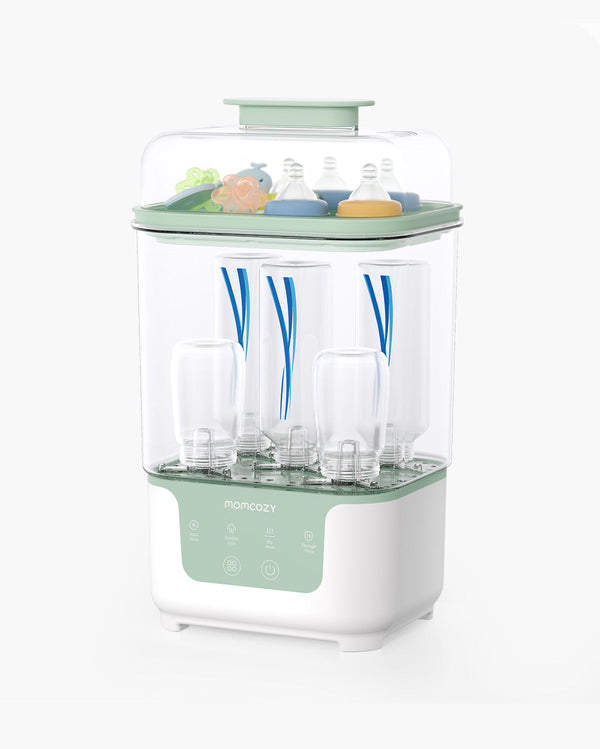
Volume decides this, not brand loyalty. At four or more bottles a day, a machine that washes, steam sterilises and dries in one 60-minute cycle removes the two worst parts of the routine: the sink session and the drying rack. The KleanPal Pro takes up to 4 bottles per cycle, runs a Rapid Wash from 19 minutes when you are behind, holds equipment for up to 72 hours in Storage mode, and uses a 2.5L tank with a direct drainage hose so you are not bailing it out by hand. If you are still working out what belongs in this category, the full bottle steriliser range is the place to start.
At one or two bottles a day, the maths is less flattering. A microwave steam bag and a rack will do the job, and the A$549.99 is better spent elsewhere. Two caveats apply either way: the 72-hour storage figure depends on the lid staying closed and the tank being clean, and descaling every 20 cycles is not optional if your water is hard. The descaling tablets and the washing block are the two consumables worth keeping in the cupboard; the machine ships with 60 official tablets in the box.
 Member price
From$549.99Code Save 25%
Frequently asked questions about stopping sterilising bottles in Australia
Can I stop sterilising bottles at 6 months?
You can usually reduce how often you sterilise, but Australian guidance does not stop at six months. Washing stays thorough after every feed, and a daily sterilising cycle is the sensible floor until 12 months. If your baby is healthy and full term, dropping from a sterilise per feed to one a day is the common middle ground.
Can I stop sterilising at 12 months?
Yes, for a healthy, full-term baby. At 12 months, hot soapy water, a good rinse and proper drying become the standard. If your baby was premature, has an immune condition or has been unwell, keep going and take the timeline from your child health nurse or paediatrician.
Do I need to sterilise bottles used only for expressed breast milk?
The bottle and teat still need sterilising before each use until 12 months. Your expressing equipment is different: the Australian Breastfeeding Association notes that for a full-term, healthy baby there is no need to sterilise your own pump parts, though they should be cleaned thoroughly at least once every 24 hours.
Do bottles need to be completely dry before use?
Dry is better, because moisture gives bacteria somewhere to live. Air drying under cover is the simplest route. A machine with a drying phase, such as the KleanPal Pro, removes the step entirely.
Does a dishwasher sterilise bottles?
No. A hot dishwasher cycle cleans well and is accepted for expressing equipment, but sterilising in Australian guidance means boiling, steam or chemical sterilisation. Dishwasher-clean bottles still need a sterilising cycle until your baby is 12 months old.
Are UV sterilisers safe to use in Australia?
They are sold widely here, but Pregnancy, Birth and Baby notes there are no national guidelines for their safe use. If you use one, follow the maker's instructions on load placement and cycle length, and do not assume UV replaces washing.
Do I need to keep sterilising if my baby was premature or we are on tank water?
Yes, in both cases. Prematurity and untreated tank or bore water are the two most common reasons Australian parents keep sterilising past 12 months. Follow your child health nurse's advice rather than a general timeline.
How long can a sterilised bottle sit before it needs redoing?
24 hours, if it has been stored dry in a clean container with a lid, and it can be kept in the fridge for that period. After that, sterilise it again before use.
The bottom line
For most Australian families the answer is 12 months, applied daily, with a 24-hour reset for any bottle that sat unused. Relaxing earlier is a judgement call that belongs to you and your child health nurse, and it depends on prematurity, illness and your water supply far more than on what a blog post says. The equipment question is separate and simpler: buy a bottle steriliser if the volume justifies it, and if you do, buy one that washes, dries and stores in a single load. That is the standard the Momcozy KleanPal Pro sets, at A$549.99, with a 1-year warranty and 60 washer tablets in the box.