What Australian workplaces should already have in place
Parental leave rarely ends on one clean date. In Australia it is usually a slow reshuffle — a few days back in the office, a handover to a grandparent or family day care, then a full week before anything feels settled.
Under the Fair Work Act 2009, an employee caring for a child of school age or younger can request flexible working arrangements, and the employer has to respond in writing. Unpaid parental leave runs to 12 months, with a further 12 available on request, and a pregnant employee who can no longer do her usual job safely is entitled to move to a safe job. The government's Paid Parental Leave scheme, administered by Services Australia, sits on top of whatever an employer offers.
What the Act does not do is set a stand-alone number of lactation breaks. That sits inside Work Health and Safety duties instead: a workplace must be safe and without risks to health, and regulators such as SafeWork NSW and WorkSafe Victoria treat a private, clean space — not a toilet, not a glass-walled meeting room — plus adequate time to express as part of that duty.
None of this solves the domestic half of the week. Someone still has to pump, label, chill, carry, warm and wash, and that someone is usually the parent who just came back. A benchtop machine such as the Momcozy KleanPal Pro does not shorten your day, but it does remove one recurring decision from the end of it.
 Member price
From$549.99Code Save 25%
 Member price
$589.00
$619.00Code Save 25% Member price
$552.99Code Save 20%

Why feeding is the hardest part to hand over
When leave ends, most couples make a fair division of the obvious tasks. Feeding is the one that resists division, and not because partners are unwilling.
- Standards feel personal. Is the bottle clean enough, is the temperature right, was that milk expressed before or after the 10am session.
- Milk is a perishable supply with a clock on it. Every bottle carries a use-by that only one person seems to remember.
- The schedule has two clients. One is an employer with meetings; the other is a baby who does not read calendars.
- Waste feels like failure. Pouring out expressed milk is emotionally expensive in a way that tipping out formula is not.
That is the invisible weight. It is not the number of tasks but the constant monitoring behind them: storage safety, session timing, cleaning standards, temperatures. Handing over a feed is easy once the standards are written down and the equipment behaves the same way every time. Until then, the parent who expressed the milk stays the default quality controller even when she is not in the room.
Build one feeding system, not a shelf of products
A return-to-work setup usually starts as a collection of purchases: a pump, a cooler bag, a warmer, a drying rack, a washer. Each one solves a task and adds a thing to track. The parent then becomes the integration layer between them, holding the whole schedule in her head.
A workable system is narrower than that. It needs four things to behave predictably — expressing, cold storage, warming and cleaning — so the handover between them needs no explanation. Under that arrangement, care becomes:
- Stable. Equipment performs the same way on a Tuesday as it did on the weekend, so nobody renegotiates the routine.
- Predictable. The same steps happen in the same order at home, at work and at childcare, which is what makes a handover possible at all.
- Shareable. A partner, grandparent or family day care educator can run the process without asking three questions first.
The test is simple. If you went away for two nights, could someone else keep the feeding going from what is written on the fridge? If the answer is no, the problem is the system, not the effort.
Simplify pumping at work
What makes it genuinely hard
Protecting a supply while holding a job is not a scheduling preference, it is a second workload. In practice it looks like this:
- Sessions squeezed between meetings, often the ones that already run late
- Interruptions that are nobody's fault and everybody's priority
- Mental arithmetic about when the next session is due, running in the background all day
- Supply worries that spike exactly when workload does
- A bag of equipment that has to be carried in, set up, packed down and carried out again
None of that is visible to colleagues. It is present all day anyway, and by Thursday the cumulative cost shows up as a dip in output that looks like a supply problem but started as a time problem.
A routine that survives a bad week
The routines that hold are the boring ones, because they do not depend on a good day.
- Book the sessions as recurring calendar blocks with a title that states the purpose, so rescheduling them becomes a visible decision rather than a silent one.
- Fix default times — mid-morning and early afternoon suits most workplaces — and treat them as fixed points that meetings move around, not the reverse.
- Keep two full sets of pump parts at work. A clean spare removes the panicked wash in a bathroom sink.
- Pack the bag the night before, with the cooler already chilled, so the morning has one less failure point.
- Tell one colleague you trust. A single person who knows why you are unreachable for 25 minutes prevents most of the interruptions.
When expressing fits inside the working day instead of competing with it, the two identities stop feeling like a trade-off. The goal is not to make motherhood invisible at work, it is to make it survivable without a daily negotiation.
Keeping expressed milk cold from desk to fridge
Where the cold chain usually breaks
The pump session is the visible part; what happens to the milk afterwards is where most of the quiet anxiety lives. Three things tend to go wrong.
- A shared office fridge that is cleaned by nobody in particular, and a door shelf that warms every time someone opens it.
- A commute that is longer or hotter than expected, especially in a car parked in the sun.
- A bottle that gets warmed twice because nobody wrote the time on it.
Storage guidance for expressed breast milk in Australia is clear enough to plan around. At room temperature of 26°C or lower, freshly expressed milk can stand for 6 to 8 hours; if refrigeration is available, it should go straight there. In a fridge at 5°C or lower it keeps for up to 72 hours, stored at the back rather than in the door. The Australian Breastfeeding Association publishes that table in full, and it is the version worth printing for the childcare bag.
Building a chain that holds
- Label every bottle with the date and time it was expressed, before it goes into the fridge. A strip of tape and a marker in the pump bag is enough.
- Use a sealed insulated bag with a frozen brick for the commute, not a plastic bag and hope. Warm days and long journeys are exactly when it matters.
- Chill the milk before adding it to already-chilled milk, rather than pouring warm over cold.
- Never refreeze milk that has thawed, and never reheat the same bottle twice.
- Ask the office facilities team where the fridge sensor sits. Milk at the back of a quiet fridge is a different proposition to milk next to a door that opens forty times a morning.
The after-work wash-up
Why it lands on one person
After a day of expressing and commuting, the bottles and pump parts are still there, and the energy to deal with them is not. Cleaning becomes the second shift: unpaid, unplanned, and impossible to skip without consequences the next morning.
What makes it stick to one person is decision fatigue, not skill. Every load raises the same questions — is this actually clean, has it been sterilised, is it dry enough to put away — and whoever holds those answers cannot delegate the job.
A routine anyone can run
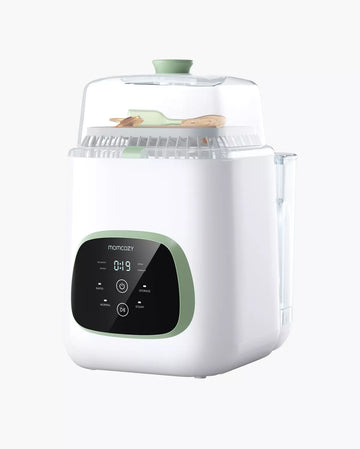
The Momcozy KleanPal Pro turns that evening job into a repeatable cycle that a partner or a grandparent can run without supervision.
- One cycle takes up to 4 bottles, or one complete set of pump parts, so the day's expressing kit goes in as a single load.
- 26 multi-angle jets at 22,000Pa do the washing, and 100°C steam handles sterilisation, eliminating 99.9% of germs.
- Rapid Wash from 19 minutes covers a late-night emergency; Normal Wash at 29 minutes is the everyday setting; Sterilise and Dry runs 60 minutes when the load is for tomorrow.
- Finished loads stay hygienic inside the machine for up to 72 hours, which removes the drying rack and the "is it still clean" question in one move.
- The 2.5-litre tank uses up to 86.7% less water than hand washing and up to 94.7% less than a standard dishwasher, which matters in a metered flat or a house on tank water.
- A direct drainage hose means no lifting a full tub into the sink at the end of it.
For the parts that only need periodic attention, descaling every 20 cycles keeps the wash performance steady — the reason the machine ships with 60 official tablets, roughly three descale cycles before you need to reorder. Replacement washing blocks and descaling tablets are listed separately if you would rather keep the supply topped up than think about it. If you are still comparing machines, the bottle washer range shows what is currently sold here rather than what is reviewed overseas.
When "done" genuinely feels done, the mental load drops. A routine that anyone in the house can start is the difference between a task and a burden.
Member price
From$549.99Code Save 25%
Member price
$589.00
$619.00Code Save 25%
Member price
$552.99Code Save 20%
Childcare, family day care and the handover
Many Australian families end up with a mix rather than one arrangement: long day care two or three days, a grandparent one day, family day care for the rest. Each setting has its own rules about bottles, and getting them right in advance prevents a lot of 7am stress.
- Long day care centres generally ask for pre-made bottles of expressed milk, labelled with your child's name and the date, rather than powder and water.
- Family day care educators often have more flexibility on timing but less fridge space, so ask before you assume.
- Occasional care and in-home care are worth registering with early, because they absorb the days when a centre is closed or a child is mildly unwell.
- The Child Care Subsidy, administered by Services Australia, applies to approved care types, so check which local services are approved before you commit to a pattern of days.
Two handover details are worth settling in the first week. The first is which bottle is for which feed, so the last bottle of the day is not the one expressed at 9am. The second is what happens at pick-up if a bottle was not finished — most services will discard it, which is another argument for sending milk in smaller amounts.
A return-to-work timeline for the Australian year
The calendar in Australia shapes a return in ways that a northern-hemisphere guide would miss, and planning around it is easier than fighting it.
- Late January and early February is the busiest time to look for a childcare place, because the school year has just restarted. Join waitlists months before you need them.
- December and January bring the summer shutdown. Many workplaces close for one to two weeks, which is a low-stakes window to trial a routine before anyone is watching.
- Summer heat from December to February makes the commute the hardest part of the cold chain. An insulated bag is not optional in a Brisbane or Perth summer.
- The end of the financial year in June is a common time for employers to review flexible arrangements, which makes it a sensible moment to renegotiate hours rather than waiting for a crisis.
Frequently asked questions about breastfeeding and returning to work in Australia
Do I have a legal right to breastfeeding breaks in Australia?
There is no single clause in the Fair Work Act that says "lactation breaks". The protection comes from two directions: the right to request flexible working arrangements when you care for a young child, and the general Work Health and Safety duty to provide a safe workplace, which regulators interpret as including a private space and reasonable time to express.
Can my employer tell me to express in the bathroom?
A toilet or bathroom is not accepted as a suitable space. The accepted standard is a private room that can be locked or screened, with a chair, a power point and somewhere clean to set equipment down.
How long can expressed milk stay in a shared office fridge?
Up to 72 hours in a fridge at 5°C or lower, stored at the back rather than in the door. Label it with the date and time, and if the fridge is shared, use a sealed container so nothing else touches the bottle.
Do I need to sterilise pump parts at work?
Pump parts mainly need thorough cleaning rather than sterilising. The Australian Breastfeeding Association advises cleaning all expressing equipment at least once every 24 hours — more often if you only express occasionally — and says there is no need to disinfect or sterilise your own kit if your baby is full-term and healthy. Bottles are a different matter: Pregnancy, Birth and Baby recommends sterilising feeding bottles and equipment until your baby is 12 months old.
Is a bottle washer worth it if I only express three days a week?
It can be, because the value is in the handover rather than the volume. Three days of expressing still produces three days of bottles and parts, and a machine that runs the same cycle every time is what lets someone else take that job.
How do I keep milk cold on a long commute in summer?
Use an insulated bag with a frozen brick, keep the bag out of direct sun, and put the milk in the fridge as soon as you arrive. On days above 30°C, treat the commute as the riskiest part of the chain rather than the pump session.
What if my baby refuses a bottle at childcare?
It is common in the first fortnight and usually resolves with repetition and the right bottle. Offer a bottle at home in the week before care starts, let the educator try before your baby is overtired, and keep the amounts small so a refused bottle is not a wasted 150 millilitres.
Where to get support in Australia
- The Australian Breastfeeding Association runs a 24-hour helpline on 1800 686 268, staffed by trained volunteers.
- healthdirect offers a nurse advice line on 1800 022 222 and publishes guidance on expressing and storing breast milk.
- Your GP, midwife or child health nurse can refer you to an International Board Certified Lactation Consultant if supply or latch becomes a problem.
- The Fair Work Ombudsman publishes plain-language guidance on flexible working arrangements and parental leave, and can be contacted directly if a request is refused without a written reason.