It is 10 pm, the bench is covered in bottles, teats, rings and valves, and by morning there will be another load. A bottle that looks clean can still hold a thin film of milk, and that film is where bacteria multiply. This guide sets out the routine Australian parents are actually given: how to hand wash every part, when a dishwasher is good enough, how to sterilise with boiling water, steam or a machine, and how long clean equipment stays safe. It follows Pregnancy, Birth and Baby, the Australian Breastfeeding Association and CHOICE, because the Australian rules differ in small but important ways from the American ones.
Why cleaning and sterilising matters for Australian babies
Milk is the perfect medium for bacteria to grow in, which is why anything that has touched milk needs cleaning. Babies are not born with a fully developed immune system, so they are less able than adults to deal with the infections that contaminated feeding equipment can pass on. Pregnancy, Birth and Baby puts it plainly: if your baby drinks milk that contains germs, they might get sick.
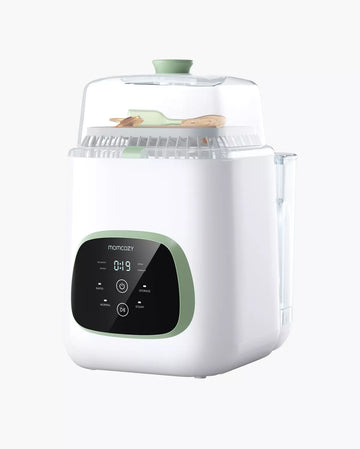
Where the volume becomes the real problem, the machine that handles all three steps in Australia is the Momcozy KleanPal Pro: it washes, steams at 100°C and dries up to four bottles in one closed cycle. This guide uses it as the reference machine throughout.
 Member price
From$549.99Code Save 25%
 Member price
$589.00
$619.00Code Save 25%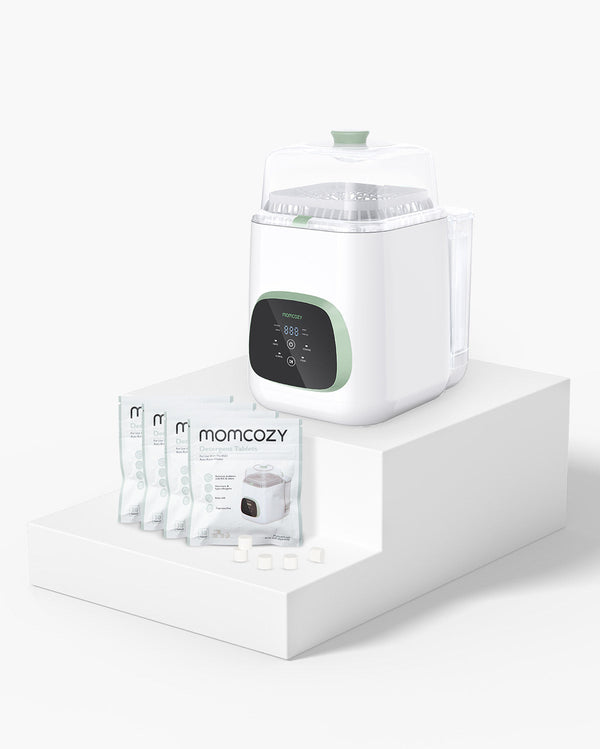 Member price
$552.99Code Save 20%

The look of a bottle tells you very little — even bottles and teats that appear clean may still carry germs. The milk film on the inner wall, the residue in the thread where the screw cap turns and the milk trapped in a teat hole are invisible when you hold the bottle up to the light. Washing is measured by whether you pulled the bottle apart and scrubbed every surface, not by whether it looks shiny.
Australian advice adds two rules many parents only discover later: formula-fed babies should get a sterilised bottle and teat before each use, and sterilising is recommended until your baby is 12 months old. Bottle feeding your baby sets out both, and that 12-month mark is one of the clearest differences from American guidance. Two rules, four or more bottles a day and twelve months adds up to a lot of cycles.
Momcozy KleanPal Pro at a glance
The KleanPal Pro is the bottle washer Momcozy sells in Australia, at A$549.99. Every figure below comes from the Momcozy AU product page, not a US listing.
- Capacity: up to 4 bottles in a single cycle
- Washing: 22,000Pa of wash pressure through 26 multi-angle jets
- Modes: 9 combinations, including Rapid, Normal, Steam and Storage
- Cycle times: Rapid Wash from 19 minutes, Normal Wash 29 minutes, Sterilise and Dry 60 minutes
- Storage: up to 72 hours of hygienic storage once a cycle finishes
- Water: a 2.5L tank per cycle
- Water use: up to 86.7% less than hand washing and up to 94.7% less than a standard dishwasher, as stated by Momcozy
- Steam: 100°C
- Germ claim: Momcozy states the unit eliminates 99.9% of germs
- Materials: food-grade and BPA-free
- In the box: 60 official bottle washer tablets; 1-year warranty;
 Member priceFrom$549.99Code Save 25%
 Member price$589.00
$619.00Code Save 25% Member price$552.99Code Save 20%
Which bottle parts need washing after every feed
Most cleaning failures are not failures of effort. They are parts that never made it into the basin.
Parts to wash after every feed
Pregnancy, Birth and Baby is explicit that all bottle parts, teats and screw caps need cleaning after every use. In practice that means:
- The bottle body, where milk clings to the curve at the base
- The teat, the most vulnerable part because of the hole and the thin silicone
- The teat ring or screw cap, where milk dries hard in the thread
- The cap or lid, the part most often left on the bench
- Vent and anti-colic components, including the small valves and the scoop, if it was wet
When to replace teats and bottle parts
Worn parts cannot be cleaned properly: the cracks and cloudiness that hold milk are the places a brush cannot reach. CHOICE recommends inspecting teats often, pulling on the bulb to test its strength, and discarding worn ones immediately.
- Silicone teats tolerate repeated washing, boiling and sterilising far better than rubber, which goes sticky and friable
- Replace a teat at the first sign of stickiness, cracking, cloudiness, a collapsed bulb or a change in flow
- Replace bottles when you can see cracks, chips or scratched, cloudy walls that will not come clean
- Pregnancy, Birth and Baby advises replacing bottles, teats and equipment as they show signs of wear
- With daily use and daily sterilising, most parents end up replacing teats every few months, but the signs above matter more than any calendar
How to hand wash baby bottles, step by step
Hand washing needs nothing beyond a basin, a bottle brush and dishwashing liquid, which is why it remains the fallback for small batches, travel and nights when the machine is already full. The sequence follows the method Pregnancy, Birth and Baby sets out.
Step 1: Wash your hands and set up a clean basin
- Wash your hands with soap and warm water, then dry them on paper towel or a clean cloth towel
- Keep a basin and brush for baby equipment only, because a kitchen sink and its sponge carry plenty of germs
- Replace the brush once the bristles are worn, and keep a small teat brush for the inside of teats
Step 2: Pull the bottle apart and rinse
- Separate every part, and pull the teat out of its screw cap so both can be cleaned properly
- Rinse in cold water first, which removes the bulk of the milk before you add detergent
- Keep parts out of the sink itself, and rinse under running water rather than in a plugged basin
Step 3: Scrub in hot soapy water
- Use hot water and dishwashing liquid in the basin, and work the brush into every surface
- Brush the thread where the cap screws on, the inside shoulder of the bottle and the base
- Squeeze hot soapy water through the teat hole, then repeat with clean water to flush it through
- Turn the teat inside out and scrub it with the teat brush, because milk sits in the folds
Step 4: Rinse twice, air dry and store
- Rinse everything at least twice in hot water, which removes detergent residue as well as loosened milk
- Drain bottles and parts upside down on clean paper towel or a clean cloth, and cover them while they air dry
- Skip the tea towel you use for the rest of the dishes, because it puts germs straight back onto clean parts
- Check no water droplets remain before the parts go away, then store them dry in a clean container with a lid
- Wash the brush and basin every few days, and check the drying rack for mould, which grows fast in a rack left in water
Do you need a special baby bottle soap?
No. The Australian method is hot water and ordinary dishwashing liquid, and no health authority here recommends a dedicated bottle soap as a necessity. What matters is that the detergent cuts through milk fat and that you rinse it off properly.
- Choose a plain, low-fragrance dishwashing liquid and avoid heavily perfumed or antibacterial products
- Avoid bleach-based kitchen cleaners for routine washing; bleach belongs only to the chemical sterilising method, used exactly as directed
- Never put dishwashing liquid in a bottle washer, because it foams far beyond what the machine can handle; use the tablets made for the unit
Member priceFrom$549.99Code Save 25%
Member price$589.00
$619.00Code Save 25%
Member price$552.99Code Save 20%
How to sterilise baby bottles once they are clean
Sterilising only works on clean equipment, so wash first and sterilise second. Pregnancy, Birth and Baby lists three methods for formula-feeding equipment — boiling, steam and chemical — and each has a place in an Australian kitchen. If you would rather not boil, compare the options in our bottle steriliser range before buying an appliance.
The boiling method
Boiling is the cheapest option, and the one to use if you only sterilise occasionally.
- Put every part of the cleaned bottle, including teats, into a large saucepan
- Add enough tap water to cover everything, and check no air bubbles are trapped inside the bottles
- Bring to the boil and boil with the lid on for 5 minutes
- Let the equipment cool in the saucepan before lifting it out, then air dry it on a clean towel and store it in a clean container with a lid
- Keep children away from the saucepan, and never leave boiling water within reach
Steam and microwave sterilisers
Steam sterilisers heat water to boiling point and rely on the steam to kill bacteria, which makes them quick and cheap to run. Pregnancy, Birth and Baby advises choosing a unit that meets Australian Standards and following the manufacturer's directions on how much water to add.
- Leave space between bottles, teats and screw caps so steam can circulate around every surface
- Run the cycle for the full time set by the manufacturer rather than cutting it short when you are tired
- Microwave sterilisers and steam bags suit travel and occasional use, but check your microwave is large enough first
- A built-in drying cycle is worth having in Australia, where a humid climate can leave wet bottles sitting damp on the bench, as BabyCenter notes
- UV cabinets are widely sold here, but read the caveat below before relying on one
Chemical sterilising and UV cabinets
Chemical sterilising uses a bleach-based solution or tablet, and it needs more care than the other two methods.
- Prepare the solution exactly as directed, and make a fresh batch every day
- Use a plastic or glass container large enough to hold everything, with no air trapped and all parts covered
- Leave the equipment in the solution for the recommended time; there is no need to rinse it afterwards
- Throw the solution out after 24 hours, wash the container, and keep all chemicals out of reach of children
- On UV: cabinets are available in Australia, but there are no national guidelines for their safe use, so boiling and steam remain the reference methods
How to wash bottles in the dishwasher
A dishwasher is the least effort option if you already run one, but only for parts the manufacturer marks as dishwasher safe. Treat it as a washer, not a steriliser.
What is dishwasher safe, and how to load it
- Glass bottles are the most tolerant and can go on any rack
- Plastic bottles belong on the top rack, away from the heating element, to avoid warping
- Silicone teats are usually dishwasher safe on the top rack; rubber teats are more fragile and safer washed by hand
- Decorated bottles, valves and fine membranes should be checked against the manufacturer's instructions first
- Separate every bottle into its parts and rinse off loose milk before loading
- Put teats, rings and valves in a closed basket or mesh bag so they cannot drop into the filter
- Choose a hot wash with a drying cycle, and use the hottest program the parts are rated for
- Wash your hands before unloading, let damp parts air dry on a clean towel, and store the dry parts in a clean, closed container rather than leaving them in the machine
A dishwasher cycle is not one of the three sterilising methods Australian guidance lists, so formula-fed babies still need a sterilised bottle and teat before each feed.
How to clean bottles with a bottle washer
A bottle washer takes the whole job in one cycle: wash, steam and dry, with the parts in a closed cabinet afterwards. It saves the most time in households washing four or more bottles a day, and removes the drying step that humid kitchens make slow. Our bottle washer range lists the sizes available here.
Member price
From$549.99Code Save 25%
Member price
$589.00
$619.00Code Save 25%
Member price
$552.99Code Save 20%
The daily KleanPal Pro routine
- Wash your hands, then tip out leftover milk; Momcozy's guidance is that a separate hand wash beforehand is not needed
- Load bottles upside down with each opening over a spray jet, up to 4 bottles per cycle
- Put teats on the teat racks and caps, rings and valves on the upper rack
- Fill the 2.5L tank to the MAX line; if your tap water is hard, a filtered supply will reduce scale
- Drop in one bottle washer tablet — 60 come in the box — and never substitute dishwashing liquid
- Choose a cycle: Rapid Wash from 19 minutes, Normal Wash 29 minutes, or Sterilise and Dry at 60 minutes
- Unload with clean hands once the cycle finishes, or leave the load in Storage mode for up to 72 hours
Descaling and everyday care
- Descale every 20 cycles with Momcozy Descaling Tablets; in areas with hard water, do not stretch the interval
- Check the direct drainage hose is not kinked, and empty the wastewater container after the last cycle of the day
- Wipe the door seal and leave the lid open between uses so the interior dries out
- Keep the receipt, because the unit carries a 1-year warranty
- Only load parts rated for the machine, and never put anything with a motor or exposed electronics inside
Which method suits your family
There is no single best method. The best one is the method you will still be doing at 9 pm on a Wednesday, six months in.
A quick way to choose
- Hand washing plus boiling: best for small batches, travel, occasional bottle use, and anyone who does not want another appliance on the bench
- Dishwasher plus a sterilising step: best for households already running a dishwasher, with bottles marked dishwasher safe
- Bottle washer: best for formula feeding or daily pumping, where four or more bottles go through every day and drying is the step that breaks the routine
- Premature or unwell babies: follow your doctor or child health nurse rather than a general guide, because the advice can differ
- Budget: hand washing costs the least, a dishwasher costs nothing extra if you own one, and a microwave steam steriliser starts around $16, as listed by ProductReview; the KleanPal Pro sits at A$549.99 with tablets included
How often should bottles be cleaned and sterilised?
Bottles need washing after every feed, with soap and water rather than a rinse. If you cannot clean one straight away, rinse it with clean water so the milk does not dry on, then wash it properly later.
The 12-month cut-off and the 24-hour rule
Two timings catch Australian parents out, and both are worth putting on the fridge.
- Sterilise until your baby is 12 months old, and plan to move away from bottles around the same age
- If a sterilised bottle has not been used after 24 hours, sterilise it again before use
- Sterilised equipment can be stored in a clean container with a lid, or in the fridge for up to 24 hours
- Formula feeding means a sterilised bottle and teat before each use, not just once a day
- For expressed breast milk, washing with warm soapy water is usually enough if your baby is full term and healthy
- Newborns, premature babies and babies who are unwell need the daily routine without shortcuts, and a child health nurse can confirm what applies to your baby
Common bottle cleaning mistakes
Most mistakes are made by tired parents doing their best at the end of a long day. They are also easy to fix.
Member price
From$549.99Code Save 25%
Member price
$589.00
$619.00Code Save 25%
Member price
$552.99Code Save 20%
Water temperature: what is too hot
There is no need to boil water for washing. The Australian method is hot water from the tap with dishwashing liquid, hot enough to cut through milk fat but still comfortable on your hands. Water you cannot put your hand into adds a scalding risk with a baby on your hip, and does nothing extra for the wash.
- Test the water with your wrist before parts go in
- Never microwave a bottle of milk to warm it, because microwaves heat unevenly and can cause burns; stand the bottle in warm water instead
- Follow the teat manufacturer's temperature advice if it gives one, since silicone and rubber tolerate heat differently
Products and habits to avoid
- Bleach and bleach-based sprays on bottles outside the chemical sterilising method
- Antibacterial dishwashing liquids and anything heavily perfumed, which leave residue behind
- Topping up a part-drunk bottle, or keeping leftover formula for later; throw out what is left at the end of the feed or after one hour
- Storing damp bottles in a closed cupboard, which is how mould starts
Cleaning for newborns, premature babies and expressed milk
Newborns, babies born early and babies who are unwell need the full routine every day, without the shortcuts that are fine for an older, healthy baby. If your baby is sick, was born premature, or you have an infection on either breast or nipple, ask your doctor or child health nurse rather than relying on a general guide like this one.
Cleaning pump parts and storing expressed milk
The Australian Breastfeeding Association has slightly different advice for expressing equipment, and it is worth knowing before you spend an hour scrubbing.
- Clean all expressing equipment, including collection parts and storage containers, at least once every 24 hours
- If your baby is healthy and born at full term, there is no need to sterilise your own expressing equipment; hot soapy water is enough
- Expressing several times a day? Store the unrinsed parts in a clean, closed container in the fridge between sessions
- Pump tubing does not contact milk, so it only needs cleaning if the manufacturer says so
- Store the dry kit in a clean, covered container or closed bag
- Expressed breast milk keeps for 6 to 8 hours at room temperature up to 26°C and up to 72 hours in a fridge at 5°C or below, according to Pregnancy, Birth and Baby
- Sterilise the bottle and teat before offering expressed milk, and throw out anything left at the end of the feed or after one hour
If the routine already feels heavy, the pattern that helps most is one pass at the end of each day rather than a rescue mission every second morning: wash, sterilise, dry, store with a lid. Keep the dry parts in a clean container with a lid, and refrigerate anything you will not use within 24 hours.
Member price
From$549.99Code Save 25%
Member price
$589.00
$619.00Code Save 25%
Member price
$552.99Code Save 20%
Frequently asked questions about cleaning baby bottles in Australia
Do I really need to sterilise bottles until 12 months?
Yes. Australian guidance recommends sterilising bottles and feeding equipment until your baby is 12 months old, and suggests stopping bottles around that age. The reason is not that older babies are fragile, but that milk is such a good medium for bacteria that the risk stays meaningful while bottles remain a daily part of feeding.
Do I need to sterilise bottles if I only use expressed breast milk?
Not always. If your baby is full term and healthy, washing bottles and pump parts in hot soapy water is usually enough, and the Australian Breastfeeding Association does not ask you to sterilise your own expressing equipment. Formula feeding is different: a sterilised bottle and teat before each use is the standard advice there.
Can I use tap water to wash and sterilise bottles in Australia?
Yes. Tap water is what the Australian method assumes, both for washing and for the boiling method, where the saucepan is filled from the tap and boiled for 5 minutes with the lid on. There is no need to buy distilled water for routine washing. If your area is on a boil-water notice, follow your water supplier's advice until it is lifted.
Is a UV steriliser as good as steam?
There are no national guidelines in Australia for the safe use of UV sterilisers, even though the cabinets are widely sold. Boiling, steam and chemical sterilising are the three methods Australian guidance sets out, so a UV cabinet is best treated as an addition rather than a replacement.
Can baby bottles go in the dishwasher with the rest of the dishes?
Yes, provided every part is marked dishwasher safe: small parts in a closed basket, plastic on the top rack, a hot cycle with drying. What a dishwasher does not do is replace sterilising, so bottles for a formula-fed baby still need one of the three sterilising methods afterwards.
How long can a sterilised bottle sit before I need to sterilise it again?
Twenty-four hours. If a sterilised bottle has not been used within that window, sterilise it again before it goes near your baby. Storing the dry parts in a clean container with a lid, or in the fridge, keeps them clean for that period but does not extend it.
What is the fastest way to clean four or more bottles a day?
A bottle washer, because washing, steaming and drying happen in one closed cycle you can walk away from. The Momcozy KleanPal Pro handles up to 4 bottles at a time from 19 minutes on Rapid Wash and holds them in hygienic storage for up to 72 hours, which is what makes the 10 pm bench session disappear.